Chinese capital banks on cultural blend to establish itself as a major presence in the international market
Culture is a lot more than just pretty pictures hanging on a wall, a ballet dancer gliding across a stage or a visit to a museum. Culture is also money, and in the cases of cities like London, Paris and New York, very big money indeed. Aware of the strong economic pulling power of culture, Beijing, with more than 3,000 years of history and a rich cultural heritage, is trying to shape itself into a world cultural metropolis on par with other renowned cultural centers.
|
 Visitors at a small outdoor market walk past paintings for sale in Beijing on Sept 8. [Photo/Agencies] |
Those efforts are being reinforced at a national level, where in the 12th Five-Year Plan (2011-15) the country's cultural and creative industry receives particular attention, and the sector has become one of the economy's most vigorous in recent years.
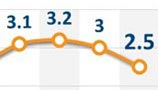
Beijing recorded the slowest economic growth among China's provincial-level jurisdictions in the first six months of the year and, surveying alternative areas for growth, has been looking to culture as one of the key industries.
"Encouraging Beijing's cultural and creative industry to develop is key to adjust the city's economic structure and change the way we grow," says Li Jiansheng, director of the institute of culture of Beijing Academy of Social Sciences.
"Culture is not only energy-efficient, but will also largely promote consumption and boost many related industries."
The vitality of Beijing's cultural and creative industry has already spurred local economic growth, particularly since the Olympics in 2008, he says.
"When you compare Beijing's cultural and creative industry with that of other big Chinese cities, looking at the value added and what that is as a proportion of GDP, Beijing is the leader," Li says.
|
|
The turnover of Beijing's cultural and creative industry was more than 900 billion yuan ($142 billion, 112 billion euros) last year, the Beijing Cultural and Creative Industry Promotion Center says. That was an increase of 21.1 percent on the previous year and accounted for 12.2 percent of the city's GDP, it says. The number of people in Beijing working in the sector reached 1.4 million by the end of last year, 14.6 percent higher than in 2010.
More than 8,500 companies are active in the Beijing cultural industry, which is 15 percent of the country's total.
People in Beijing are also showing an increased willingness to spend money on cultural and recreational services. Last year they spent an average of more than 2,100 yuan, more than the residents of any other city, and a rise of 14 percent on the previous year.
"The cultural and creative industry in Beijing is close to the level of New York, London, Tokyo and other world cities in people employed, the number of museums and the number of movie screens per person," Li says.
"Beijing needs to take advantage of its favorable conditions to further develop the industry so as to enhance its international influence."
There is little doubt that in that respect Beijing, as the national center of politics, culture and international exchanges, enjoys a unique advantage. That has helped it attract more and more talent and big cultural enterprises from elsewhere.
Beauty Media, a Chinese private cultural media enterprise, is one such.
Founded in 1994 in Guangzhou, Beauty Media specializes in broadcasting, cinema and television production, audio-visual programming, creative animation and derivative products. In August 2008 it moved its headquarters from Guangzhou to Beijing.
For Li Feng, vice-president of Beauty Media, the move was strategic. "Beijing is the right place to make our company bigger and stronger," she says.
When China's audiovisual industry faced industrial upgrading challenges from digital media, her company also encountered hurdles, she says.
"Although Guangzhou is one of China's biggest cities, it lags behind Beijing in terms of cultural environment and information flow, so we decided to move our headquarters to Beijing to seek more opportunities."
The decision appears to have been a wise one. Since Beauty Media arrived in the capital, it has rapidly expanded, making a name for itself as a program producer and distributor nationwide and becoming a big cultural exporter.
In 2009 it acquired International Chinese Television Network, becoming the first Chinese media enterprise to gain access to the digital terrestrial broadcast network and the largest Chinese television media entity in the United States.
ICN has 16 channels, covering Los Angeles and San Francisco in California, Seattle in Washington state, Austin, Dallas and Houston in Texas, New York, and Vancouver and Toronto in Canada. About 100 million viewers in North America can watch by wireless or cable its 24-hour free program covering various aspects of China.

Copyright 1995 - . All rights reserved. The content (including but not limited to text, photo, multimedia information, etc) published in this site belongs to China Daily Information Co (CDIC). Without written authorization from CDIC, such content shall not be republished or used in any form. Note: Browsers with 1024*768 or higher resolution are suggested for this site.
License for publishing multimedia online 0108263 Registration Number: 130349