WASHINGTON -- American solar businesses may see cost double when they paid the Chinese factories, as US Commerce Department on Wednesday affirmed steep punitive tariffs on Chinese solar panels.
The department made a final determination that Chinese producers and exporters sold crystalline silicon photovoltaic cells, whether or not assembled into modules, in the US market at dumping margins from 18.32 to 249.96 percent, and received countervailable subsidies of 14.78 to 15.97 percent to manufacture these solar panels.
Related reading:??US affirms punitive duties on China's solar cells
These trade remedy cases divert public attention toward a small group of US solar energy manufacturers, but run counter to the wishes of the larger numbers involved in distribution.
According to a study by the Brattle Group, a US consulting firm, for each megawatt of new solar capacity installed in this country, only three out of 30 jobs in need are in manufacturing.
"Global research, innovation, and competition have dramatically improved efficiency and lowered production costs. But the continuation of this global effort is at risk because of a short-sighted and protectionist trade action filed by SolarWorld," said the Coalition for Affordable Solar Energy, or?CASE, a coalition of US companies that sell and install solar panels.
US Commerce Department initiated antidumping and countervailing investigations in November at the request of Germany's SolarWorld American entity located in the US state of Oregon.
It is clear that SolarWorld, "in an attempt to obtain government intervention to raise the price of solar energy, is willing to threaten the future growth of America's solar industry to achieve its own goals," said CASE in a hearing on Oct 3 before the International Trade Commission.
The commission has the right to overrule the initiative to implement antidumping and countervailing duties if it makes a negative determination that Chinese solar panels do not materially injure or threaten material injury to the US industry. The commission is scheduled to make its final determination on or before Nov 23, 2012.
CASE also claimed that "the structure of US solar programs and competition with natural gas have been the forces behind driving down the price of solar cells, not imports from China".
The US government neglected the benefits that the Chinese imports have brought to the US solar industry.
With competitive and affordable Chinese solar panels, US photovoltaic installations totaled 742 megawatts in the second quarter 2012, up 45 percent over the prior quarter and 116 percent over the same period last year.
More importantly, Chinese imports have driven solar energy cost down dramatically and benefited US end users. The average price of a solar panel halved in 2011, according to the US Solar Energy Industry Association.
Another fact which is often left unknown is that the United States is a net solar product exporter to China with a surplus of more than $240 million in 2010, according to the latest US solar energy trade assessment by the industry group.
The largest solar energy export product is poly-silicon, the feedstock for crystalline silicon silicon photovoltaic cells, of which the United States exported $2.5 billion in 2010. The second largest solar energy export product is silicon photovoltaic capital equipment, the manufacturing equipment for silicon photovoltaic products, of which the United States exported $1.4 billion in 2010.
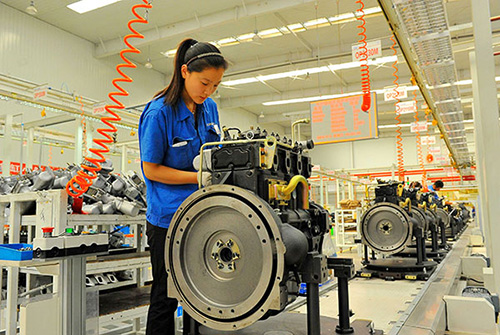
It is clear that China plays a role of combining the US high-tech machine and solar components with its scale of manufacturing. It exemplifies how globalization works to reduce energy cost.
"Without the technical improvements and volumes to lower costs, commercially viable approaches will remain unrealized," said Yukon Huang, senior associate at Washington think-tank Carnegie Endowment for International Peace.
He also noted that given the environmental and energy security benefits, most countries provide subsidies.
With US funding for clean energy drying up and pressures to develop lower cost approaches mounting, both sides should channel their political capital into encouraging mutually beneficial arrangements rather than entering into protectionist battles, said Huang.


Copyright 1995 - . All rights reserved. The content (including but not limited to text, photo, multimedia information, etc) published in this site belongs to China Daily Information Co (CDIC). Without written authorization from CDIC, such content shall not be republished or used in any form. Note: Browsers with 1024*768 or higher resolution are suggested for this site.
License for publishing multimedia online 0108263 Registration Number: 130349