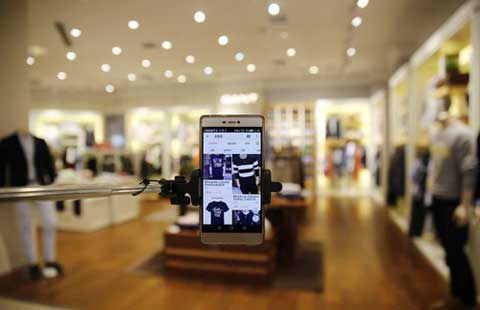
The US search engine giant Google Inc has been trying to push its way into mobile advertising in China as the country expects to overtake the United States to be the world's biggest smartphone market this year.
|
 |
|
 |
Mobile advertising is one of the few high-key strategies announced by Google China, which, being low-key in itself, shrank its business portfolio in the country last month amid a declining market share.
The company intends to increase its footprint in the mobile advertising sector with its solutions that enable advertisements to be shown on mobile applications, Web pages, mobile search results and online videos.
Advertisement requests in the mobile sector through Google's products increased by 120 percent from July 2011 to July 2012 in China, and the country has become one of Google's top five countries by advertising request volume, according to the company.
"It (the mobile advertising business in China) has made very good progress so far and it is a business that is growing the fastest," said John Liu, corporate vice-president of Google. He didn't elaborate on the details of mobile advertising in the country.
While Google pins its hopes on the mobile advertising business in China, it is still proving to be difficult for the US company to bridge the gap with Chinese rival Baidu Inc, said analysts.
"It's possible that the mobile business will help Google to improve its performance in China," said Hong Bo, a Beijing-based IT critic who founded consultancy company IT5G.
An increasingly large number of people turn to their mobile devices to access the Internet and use mobile applications, which will enable Google to generate revenues by distributing advertisement on Web pages and applications.
However, "user experience of mobile advertisement is still not satisfactory and there are doubts about whether it's possible to make as much as money on mobile devices as on personal computers through advertisements," he added.
Robin Li, chairman and chief executive officer of Baidu, earlier expressed similar worries. The most successful business models on personal computers - advertising, online games and e-commerce - are faced with challenges on mobile devices, Li said.
"Mobile advertising is growing at a fast speed but its value is not as much as advertisements shown on PCs because of the small size of mobile phone screens and the fragmented time users spend on them," he said in a forum in June.
Even in developed Internet markets, mobile advertising is still weaker than PC advertising in its ability to generate revenues, Li added.
It's not known how much mobile advertising contributes to Google's total revenues. However, Jim Friedland, an analyst with US-based financial services company Cowen Group Inc, estimated earlier this year that mobile advertising accounted for 3 percent of Google's total revenues in 2010, 7 percent last year, and will almost double to 13 percent in 2012, according to a report by technology website Techcrunch.com.
In China, mobile phones are currently the most widely used devices to access the Internet. The number of people accessing the Internet via mobile devices increased to a record high of 388 million at the end of June, according to a report by the China Internet Network Information Center.
China is also expected to overtake the US to become the world's biggest smartphone market this year, according to a report by market research company IDC in August.
In the second quarter, Baidu had 78.6 percent of the search market in China, measured by revenues, while Google had 15.7 percent, according to domestic research company Analysys International.
The US search giant reached its peak in China in the fourth quarter of 2009, holding 35.9 percent of the market, but the gap between Baidu and Google is now growing, especially after Google moved its servers and redirected mainland traffic to Hong Kong in 2010.
Last month, Google shut down its music-search service in China because it wasn't as influential as hoped for, further shrinking its business on the Chinese mainland. Google launched the service in 2009, aiming to fend off competition from Baidu, which at the time provided users with links to copyright-infringing music websites.
At the end of June, China had 538 million Internet users, the most in the world.
chenlimin@chinadaily.com.cn


Copyright 1995 - . All rights reserved. The content (including but not limited to text, photo, multimedia information, etc) published in this site belongs to China Daily Information Co (CDIC). Without written authorization from CDIC, such content shall not be republished or used in any form. Note: Browsers with 1024*768 or higher resolution are suggested for this site.
License for publishing multimedia online 0108263 Registration Number: 130349