Upgrading Chinese economy


Structural adjustments to realize sustainable development should go on while keeping growth within reasonable range
Having experienced rapid development for more than three decades, the most important task is economic structural adjustment, to realize both the quantity and the quality of sustainable growth.
In China, maintaining high-speed economic growth is not only an economic issue, it is also a social and political issue. In the first half of 2013, the number of university graduates increased to a record 6.99 million, while GDP growth declined to 7.6 percent, which is the lowest in the past three years. Maintaining stable economic growth is necessary as a continuing slowdown could lead to many problems in society.
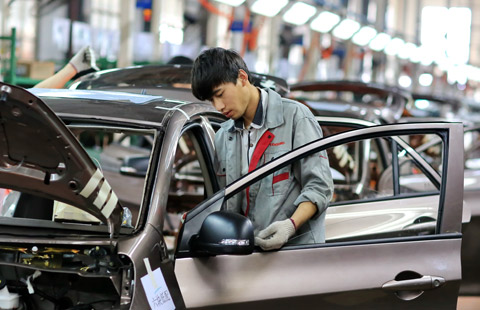
But at the same time, the extensive mode of economic growth over the last 30 years has led to serious structural imbalances, high energy consumption, low efficiency and a low technological level. China's economy urgently needs restructuring.
In fact, realizing the leadership's goals to double the 2010 GDP and double the per capita income for both urban and rural residents by 2020, which is the foundation for building a moderately prosperous society in all aspects by 2020, will be realized if the average economic growth rate is 6.9 to 7.1 percent over the next eight years.
This is actually the government's bottom line for the growth rate. If the restructuring leads to the economy slowing below this, the central government will certainly introduce stimulus packages.
But an overheated economy will not be accepted by the government either. If the economy grows too fast based on the current economic structure, it will aggravate the current imbalances, which in turn will increase the resistance to structural adjustment and undermine the economy's healthy development in the long term.
Therefore, it is necessary to set a reasonable range for economic growth, setting a floor rate that can still maintain stable growth and realize the employment goal, as well as a ceiling rate to prevent inflation.
As Premier Li Keqiang said at a conference in July, "We should not change policy orientation according to any temporary change in the economic index, otherwise it will have an impact on the hard-won opportunities and results of structural adjustment, nor should we lack vigilance and preparation for the slowdown in economy when it drops out of the reasonable range."
To be more specific, the government should prevent the economy from cooling too much and from overheating. Although there are still overheating issues in some industries because of the unbalanced development in Chinese economy, the slowing growth trend cannot be easily avoided according to the current global and domestic economic situation, so the possibility of overheating in the macroeconomy has largely declined.
It is "cold-proofing" the economy that will be tougher. Although the economy achieved a 7.6 percent growth rate in the first half of 2013, which is above the expected goal of 7.5 percent, it has slowed a lot compared to the double-digit growth rate in 2011. So keeping the growth rate above the bottom line is an important task for economic regulation, especially as the global economy remains weak, and the country's demographic dividend is gradually declining and the middle-income trap could be approaching.
As was outlined at the 18th National Congress of the Communist Party of China in November, government administration should be separated from the management of enterprises, State assets, public institutions, and social organizations, and a well-structured, clean and efficient service-oriented government should be built up. Premier Li Keqiang has always supported clarifying the boundary between the government and the market, and he wants the government to have clearly defined functions that satisfy the people.
The government acquiring public services from the market can strengthen the fundamental role that the market plays in allocating resources, and help to build a more market-oriented socialist market economic system, in which the government can carry out its own duties by providing a legal and fair market environment for the public, while the market can use prices as the leverage to better distribute resources and regulate production and consumption.
Facing the challenge of realizing economic growth in the course of restructuring, a clear boundary between the government and the market can stimulate the function of both, which accords with the economic development principle and will further upgrade the economy in the long run.
The government is accelerating the change of the country's economic development mode focusing on economic structural adjustment. This is an inevitable choice if the country is to realize further development and the only way to realize the nation's rejuvenation.
Upgrading the economy means first changing the mode of economic development from an extensive to intensive pattern, boosting its scale and efficiency. The driving force for economic growth should be technical innovation rather than the input of resources. There should be a technical innovation system with corporations as the main body that is market-based and features cooperation among enterprises, universities and research institutions. Innovation, fundamental research and the transformation of scientific research achievements should rank top with science and technology contributing more to the economy.
Moreover, the structure of the national economy should be further optimized, with the service sector leading the economy and industry being the backbone.
The imbalances and unsustainable issues in the economy can be eradicated with more effective allocation of resources, a clear boundary between the government and the market, and a fairer income distribution system.
The vision for an upgraded Chinese economy is concrete not abstract, and it is dynamic instead of static because the upgrading of the economy is not restricted. It can realize stable growth along with the restructuring, and achieve the twin targets set for 2020.
The author is a researcher with the Party School of the Central Committee of CPC.