'Quality of life, not quantity of production'


Q+A | Klaus Schwab
WEF founder: Sound fiscal policies and social equity
The 2013 Annual Meeting of the New Champions, or Summer Davos, opens today in the coastal city of Dalian.
Klaus Schwab, founder and executive chairman of the World Economic Forum, talks about his expectations for the event and issues relating to the Chinese economy in an interview with China Daily reporter Zhang Haizhou.
How many times have you been to China?
I first visited China in 1979. Since then, I have been back to China every year. What strikes me most about China is the incredible transformation it has undergone.
The world has never before experienced growth on such a scale and for such a sustained period of time. But what is most admirable is how China's growth has lifted hundreds of millions of people out of poverty, accounting for most of the improvement in global alleviation of poverty.
This year's Summer Davos is opening soon in Dalian. What major issues do you hope participants will discuss?
This year's Annual Meeting of the New Champions is taking place at a critical time in global economic history. As we try to recover from the most severe crisis in generations, we must deal with an unprecedented set of intertwined challenges. For governments, this includes the challenge of creating growth and employment while ensuring fiscal prudence, social equity and environmental sustainability. For businesses, this means adapting to new models, emerging technologies and shifting behaviors of citizens and consumers.
|
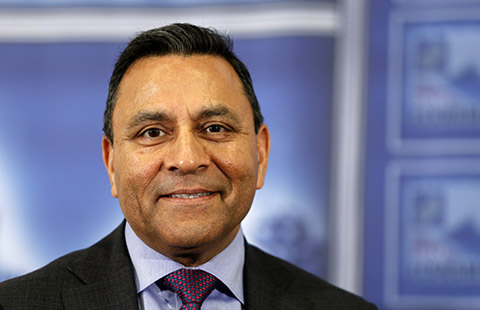
Klaus, Schwab Zou Hong / China Daily |

This points to a future where innovation will become increasingly important for economic development, competitiveness and inclusive prosperity.
The theme of this year's Summer Davos - Meeting the Innovation Imperative - means that we are entering a new era of economic growth where "New Champions" are needed to build a world in which the quality of life, and not just the quantity of production, is at the center of our activities.
My hope is that the 1,600 leaders taking part in the meeting will leave with a vision that is far-sighted, dynamic and goes beyond crisis management.
You have said you are confident about China's economy. But the country has actually begun to feel the slowdown in recent years. Do you have any suggestions for the Chinese leadership?
Growth has started to slow across many emerging economies - not just China - and advanced economies in Europe and elsewhere continue to struggle. Policymakers must press ahead with structural reforms and critical investment required to provide a prosperous environment and employment for their citizens.
For the Chinese economy in particular, there is much to be positive about - its macroeconomic situation is good, inflation is down, the budget deficit is moderate; and its public debt-to-GDP ratio is among the lowest in the world.
If China continues along this trajectory and avoids the negative effects of the slowdown, it must identify and invest in the drivers of future economic growth such as health, education and social systems. Above all, it must find innovative ways to create new value-added products, processes and business models. In short, China must also transform its economy to be more socially inclusive and more environmentally sustainable.
What are your comments on China's new leadership?
For centuries, the most important factor for governments has been to combine a strong vision with the ability to translate that vision into action - this is true statesmanship, and which I see embraced by China's current leadership.
You developed the "stakeholder" theory for businesses about 40 years ago. In the case of China, do you see State-owned enterprises as stakeholders?
The World Economic Forum stands for global citizenship. This means that our ultimate responsibility is not just to help our members and partners deliver global growth, but rather to ensure that an entrepreneurial spirit is harnessed to create an environmentally and socially sustainable future.
My concept states that all modern enterprises, be they large SOEs in China or corporations across the world, must serve all stakeholders of society. I see no difference here between State-owned and privately owned companies - they must all serve not only their owners and shareholders, but also their customers, suppliers, collaborators of any kind, as well as the government, society and the communities.
Given their importance, large SOEs, more than any other companies, must therefore adapt to today's circumstances, make the necessary adjustments to remain a key pillar of our economic system and be in service to a socially responsible market economy.
More and more Chinese firms are investing abroad now. As most of them have little experience, do you have any advice to share?
My foremost advice would be to adhere to the best global governance standards even if those standards have not yet been adopted by all European or North American companies. Global expansion means not only to invest and establish factories, it also requires a better understanding of the culture of the country you are operating in.
To be present in the global market requires the ability to integrate into international networks of informal interaction and experience exchange. This is the best way to create mutual trust. The success of the World Economic Forum is certainly based on its unique capability to enable corporations to be truly integrated into a global community that consists of business, political and all other key decision makers of society.
What is the biggest challenge faced by the world economy today?
The biggest challenge faced by the world today is the erosion of global trust and the inadequacy of our global governance system to address the most pressing issues. This system must not only be adapted to reflect the new geopolitical and geo-economic situation, but it must also reflect the core belief of the forum - to strengthen public-private cooperation. As we are living in a globalized world, I am optimistic about the future only if we create a truly collaborative global system.
(China Daily 09/11/2013 page25)