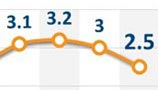
Since 2007, the average customer experience, also called CX, in the industries that Forrester tracks, has gone up across the board.
The number of poor experiences has declined quickly and the difference between the CX quality that the best and worst companies in key industries provide has narrowed dramatically. Yet it will not get any easier. With companies investing more than ever to differentiate their customer experience, the average offering will soon be considered poor.
Good customer experience will no longer be good enough. The situation in China is no exception.
Our analysis has shown that there is close to zero correlation between a high-quality customer experience and lower customer churn in China. This is a sharp contrast with the United States, where there is a moderate correlation.
Two factors contribute to this phenomenon:
· Metro consumers gravitate to new products and services. Forrester's China Technographics? data show that 67 percent of online adults in metros agree that they are willing to try or do new things, compared with just 50 percent of the online adults in the US. As multinational companies seek to penetrate this lucrative market and local brands proliferate, consumers can easily feed their desire for fresh experiences with the abundance of options available.
· Competing brands provide equally good but undifferentiated experiences. Our Customer Experience Index data show that 31 of 46 brands earned scores in the good range, while just four brands earned scores in the excellent category. What is more, the range of scores between the best and worst brands in three out of four industries was just 12 points or less. Taken together, these facts mean that the differences in CX quality from one provider to another are not great enough to prevent defection in the face of other factors such as selection and price.
In 2015, Forrester expects the global race for CX to accelerate from good to great. Smart CX teams will increasingly use customer data from diverse sources like social listening platforms, campaign management platforms, mobile apps and loyalty programs to personalize and tailor experiences in real time so that they inherently adapt to the needs, wants, and behaviors of individual customers.
Peer review influence, for instance, plays a key role in China, where approximately half of the online adults in metros rely significantly on recommendations from their friends and family when making a purchase.
As companies strive to break from the pack and gain a competitive edge through the quality of the CX they provide, we will see the battleground shift to new areas like emotional experiences and extended CX ecosystems.
In their journey toward customer satisfaction, companies will need to align the "three Es" of customer experience-effectiveness, ease, and emotion-with product strategies.
Emotion will have a bigger impact on customer loyalty than either ease or effectiveness. In the shadows of Deloitte's purchase of Doblin and Accenture's acquisition of Fjord, Forrester expects a land grab for design agencies that can provide emotional intelligence.
Startups will redefine CX ecosystems (the web of relations among all aspects of a company-including its customers, employees, partners and operating environment-that determine the quality of the customer experience).
This will force established companies and laggard industries like health insurance, TV service providers and State-owned enterprises to raise their game. Entrenched players will continue to be whipsawed by new firms taking innovative approaches to ecosystems in the markets they enter, whether it be media darlings like Airbnb (their ingenuity cost hotels more than $800 million in lost revenue last year) or trailblazers like TransferWise, which has redefined the ecosystem for currency trading by allowing people to transfer money abroad at 10 percent of the costs many banks charge.
Disrupting the financial industry in China, Internet giants Alibaba Group Holding Ltd, Baidu Inc and Tencent Holdings Ltd have each launched their own high-interest savings funds. The latter recently launched its website for what will likely be the first-ever private Internet bank in China, catering to the world's largest smartphone market with its mobile-first interface.
The value of an ecosystem will expand from one comprised primarily of "hard" elements such as devices, apps and accessories to include "soft" factors such as customer data and privacy practices, authentication protocols and payment enablement.
These soft factors will increasingly define differentiation among ecosystems, with players like Apple Inc, Google Inc and Facebook Inc competing on factors such as their ability to build extensive service partner networks and obtain customer confidence in their data use and security practices.
Yet for multinational companies in China, they will need to be mindful that embedding Apple, Google and Facebook in their networks will have limitations in the marketplace, which will lead to a subpar experience for their Chinese customers.
The need to up the customer experience game has never been greater, and much more so, in China. Companies need to assess where they are at in their CX journey and work toward aligning the "three Es" of emotion, ease and effectiveness in their customer experience strategy.
The author is vice-president and research director, Forrester Research.

Copyright 1995 - . All rights reserved. The content (including but not limited to text, photo, multimedia information, etc) published in this site belongs to China Daily Information Co (CDIC). Without written authorization from CDIC, such content shall not be republished or used in any form. Note: Browsers with 1024*768 or higher resolution are suggested for this site.
License for publishing multimedia online 0108263 Registration Number: 130349