|
 |
|
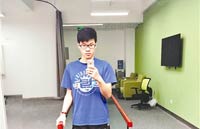
A rural resident views plants through a microscope at a plant clinic in Shunyi district, Beijing. [Wang Jing/China Daily] |
A room with a microscope, networked computer and drugs appears at first glance to be in a hospital.
But the equipment isn't for ill people. Instead, it's for sick vegetables and grain crops.
China has recently introduced "plant clinics", a new way to prevent and control plant diseases and insect pests on farmland.
Nine plant clinics to date have been jointly set up by CABI, a research group in the United Kingdom that focuses on agriculture and the environment, and agricultural authorities in Beijing and South China's Guangxi Zhuang autonomous region.
The plant clinics already are improving harvests for farmers while seeking to build public confidence in food safety by reducing the use of agrochemicals, insiders said.
Zhao Shifu, 44, an agriculture technician in Beijing's Shunyi district, began to work as a plant doctor in his spare time when a plant clinic opened in August.
Zhao, who has more than 20 years of experience curbing pests and plant diseases, said the plant clinic can do something that no other method can.
"When technicians go into the field, they visit very few farmers in a day, and the rest miss out. The clinic has proved to be the best approach to solving plant health problems since they operate regularly - just like a hospital for people," he said.
Zhao said the plant clinic that he works for, which is based in a local shop that sells pesticide and fertilizer, is far more popular among farmers than he imagined it would be.
"Even though it is now winter, the clinic still opens every day - far exceeding the original plan of being open once a week," he said.
When a farmer brings a sample of a sick crop to the plant clinic, a trained plant doctor diagnoses the problem and recommends an affordable, locally available treatment.
Meanwhile, data about the farmer's visit - location, type of crop disease and insect pest, and treatment recommendation - is entered into an electronic database which is shared with the other plant clinics in the country.
Zhang Fengquan, 52, a farmer in Beijing's Shunyi district, said the plant clinic is now her first choice when her crops are seriously affected by unknown problems that she can't control.
"Unlike agrochemical sellers, who simply recommended four or five varieties of pesticides to curb one type of crop disease, the plant doctor lets me know what happened to my crops and how to prevent such problems," she said.
Since 2007, China has been the world's largest consumer of chemical fertilizers, using more than 50 million metric tons a year, four times the amount used in the 1980s, according to the National Bureau of Statistics.
The country also uses 1.3 million tons of pesticides annually, with usage per unit area 2.5 times the global average, according to the Chinese Academy of Agricultural Sciences.
Experts say an increase in plant disease and the deterioration of the environment have been caused in part by years of heavy use of agrochemicals.
Wan Min, project manager of CABI in China, said about eight new plant clinics are scheduled to open in China next year, especially in the west, where more poor farmers urgently need technical advice.
The program has also received support worldwide: More than 1,000 plant clinics are expected to be built in about 40 countries by 2016, he said.
The Food and Agriculture Organization of the United Nations says that nearly 1 billion people in the world are going hungry every day, and over half of those are smallholder farmers who rely on income from their crops to feed their families.
At the same time, up to 40 percent of the food that is currently grown worldwide is lost to plant pests and diseases before it can be consumed.
"If we can reduce this amount by even 1 percent, we can potentially feed millions more people," said Zhang Feng, country director of CABI in China.
jinzhu@chinadaily.com.cn



Copyright 1995 - . All rights reserved. The content (including but not limited to text, photo, multimedia information, etc) published in this site belongs to China Daily Information Co (CDIC). Without written authorization from CDIC, such content shall not be republished or used in any form. Note: Browsers with 1024*768 or higher resolution are suggested for this site.
License for publishing multimedia online 0108263 Registration Number: 130349