Comments
  Print
Print  Mail
Mail Large Medium Small
As China pins its hopes for boosting consumer demand on growth in the number of urban residents, an ominous sign looms large: The pace of urbanization in the world's most populous country is slowing.
According to the latest data from the National Bureau of Statistics, China added 19.29 million people to the urban population in 2013. This seemed impressive, but it was lower than the 21.03 million new urban residents seen in 2012.
|
 Preliminary work on new housing on the site of a former shantytown gets underway in Taiyuan, Shanxi province. The pace of urbanization in China is slowing as local government debt threatens social spending plans. Liu Jing / for China Daily |
From 2008 to 2013, the urbanization rate of the country climbed from 45.7 percent to 53.7 percent. But the annual gain was smaller each year. In 2010, there was a 3.35 percentage point gain, the highest annual increase. The gain dropped by 1.3 percentage points in 2012 and then by another 1.16 percentage points last year.
"A country's urbanization pace tends to slow as it reaches 50 percent," said Song Li, a researcher at a think tank under the National Development and Reform Commission. "This means time is not on our side."
The deceleration of urban population growth is a challenge for the country's ambitious urbanization plan, but it is not the only one. The fast buildup of debt by local governments is another.
At the end of 2013, China's national auditor revealed that the direct debt of local governments had grown to 10.9 trillion yuan ($1.8 trillion) by the middle of last year. On top of that was another 7 trillion yuan in various debt guarantees.
Geographically, debt accumulated most at places where economic activity was most brisk: Jiangsu and Guangdong owe the most, accounting for 14 percent of the total.
However, debt also surged in China's poorer western provinces, where local governments desperately pursued big-ticket infrastructure projects to support urbanization.
Relative to the size of their economies, the western provinces of Guizhou, Yunnan and Qinghai bear some of the heaviest debt burdens, along with the city of Chongqing. The total debt-to-GDP ratio in Guizhou, for example, has reached a startling 80 percent.
Given the central government's increasing scrutiny (it has identified "curbing debt" as a key priority in 2014), local governments may find it difficult to pay for such things as social entitlements for local migrant workers, a key element of the "new-style urbanization".
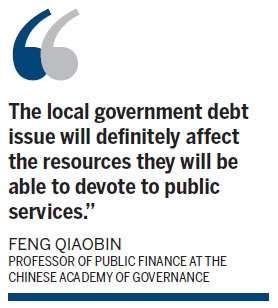
"The local government debt issue will definitely affect the resources they will be able to devote to public services," said Feng Qiaobin, a professor of public finance at the Chinese Academy of Governance.
Take Beijing, for example. The city bore 649.6 billion yuan of direct debt as of mid-2013, while its general fiscal revenue for the year was 366 billion yuan. Even with land sales revenue counted, Beijing will struggle to repay its annual principal and interest.
But analysts said this would not hinder the central government's determination to put equality in social services at the center of the urbanization program, as it was detailed in the Central Urbanization Work Conference at the end of 2013.
The conference, the first of its kind, required a "human-centric" approach - in other words, providing the country's 333 million migrant population with equal social security, public housing and education, the same as enjoyed by full urban citizens.
Two moves followed that confirmed Beijing's "human-centric" approach.
In late December, the Ministry of Public Security sketched a reform roadmap for the nation's long-criticized hukou (household registration) system. By 2020, the ministry will establish a new system based on regular places of residence and stable jobs, rather than on a person's place of origin.
Moreover, the State Council announced on Feb 7 that the national pension insurance system for rural and urban residents would be unified to provide equal access for all.
Experts said both the hukou and pension insurance reforms require money, as the government raises the subsidy for rural hukou holders. A possible solution to the money gap, provided by the Third Plenum of the 18th Central Committee of the Communist Party of China in November, is to set up a mechanism matching the rate of fiscal transfer payments from the central government with the pace at which farmers become local urban residents. The more a city absorbs migrant workers, the more money it would receive from the central government.
Another solution would be to boost local governments' coffers to meet their heavy spending responsibilities, public finance professor Feng said. But the first task, Feng said, is to expand the tax revenue base of local governments, which could be accomplished by expanding property taxes and other taxes.


Copyright 1995 - . All rights reserved. The content (including but not limited to text, photo, multimedia information, etc) published in this site belongs to China Daily Information Co (CDIC). Without written authorization from CDIC, such content shall not be republished or used in any form. Note: Browsers with 1024*768 or higher resolution are suggested for this site.
License for publishing multimedia online 0108263 Registration Number: 20100000002731