Call for greater Chinese investment in Brazil
BRASILIA, Brazil: A senior Brazilian diplomat is calling for more Chinese enterprises to invest in Brazil, the largest economy in Latin America.
Roberto Jaguaribe Gomes de Mattos, undersecretary-general for political affairs of the Brazilian Ministry of External Relations, said in a recent view that "Chinese investment in Brazil can increase significantly."
Recommending the sectors of mineral resources, energy, primary products, information technology, pharmaceuticals, paper pulp, agribusiness and iron and steel to potential Chinese investors, he said: "I see tremendous opportunities (for Chinese investment in Brazil)."
|
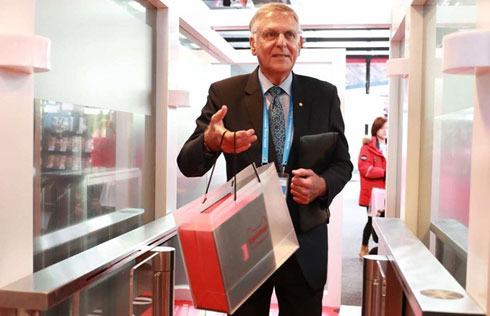
Roberto Jaguaribe Gomes de Mattos. |

According to figures from the Chinese Ministry of Commerce, Chinese enterprises invested nearly $100 million in Brazil by the end of June this year, largely in industries like mining, telecommunications, trade, services, lumber processing and assembly line production of household electrical appliances.
Meanwhile, Brazilian investment in China hit $210 million, most of it going to the manufacturing, real estate and hydropower industries.
But in terms of the gigantic size of the Chinese economy, the nation's investments in Brazil seem quite small.
Brazil takes a leading position in the world in the sectors of renewable energy resources, civil aviation, agribusiness, paper pulp and minerals - where Chinese investors have great opportunities.
Regarding bilateral trade, Mattos said that China is one of Brazil's most important trade partners in Asia.
In Asia, "Japan is a traditional partner, India is a new partner, but China is a very significant partner," he noted.
Trade between China and Brazil hit $12 billion in the first half of 2007, a year-on-year increase of 30.1 percent, according to statistics from the Chinese Ministry of Commerce.
Brazil is now one of China's main suppliers of iron ore and soybean and China a fast-growing supplier of electronic goods and components to the South American nation.
Bilateral trade reached $20.3 billion last year.
In Brazil, the continuous appreciation of its currency against foreign currencies, economic growth and domestic income hikes have helped boost imports, including those from China.
As a result, Brazilian supermarket shelves are increasingly filled with imported products, especially goods from China, which has enabled ordinary consumers in Brazil to have access to electronic products and other cheaper items.
Although some in Brazil express concern at the rise in exports of Chinese-manufactured products to their country, this trend has been mostly beneficial for Brazil, to the extent that it has reduced costs in their industry and made it more competitive internationally.
Mattos said the two countries are enjoying a very close partnership and Brazil is a very good partner of China in the Americas.
"We are ready to reach a rich level of bilateral relations," he noted.
To further enhance mutual understanding and bilateral relations, he said that the two countries should increase high-level visits, covering government authorities, media, businesses, culture and trade unions.
In the international political arena, the two countries have cooperated on important issues, especially related to topics of great significance for developing countries, such as WTO trade negotiations, development financing, and the struggle against poverty.
Brazil and China can help each other on issues like climate change, biodiversity, global warming and biofuel, he said.
"We both believe dialogue is the best procedure to deal with world issues."
Satellite program

Sources at the Brazilian National Institute for Space Research (INPE) based in Sao Jose dos Campos said recently that Brazil and China may continue their cooperation in earth resources satellite programs after the current program is completed in a couple of years.
The two countries started the China-Brazil Earth Resources Satellite Program (CBERS) after signing an agreement in July 1988 and have since launched their first two joint satellites - CBERS-1 and CBERS-2 - both of which have experienced great success.
Given the success of the cooperation, Brazil and China decided to continue their CBERS program by signing a new agreement in November 2002 for the manufacture and launch of two new satellites - CBERS-3 and CBERS-4.
With improved characteristics and more advanced design, the two new remote sensing satellites are expected to be launched in 2008 and 2010 respectively.
Agricultural co-op
Brazilian Agricultural Research Corporation (Embrapa) is willing to explore new frontiers of cooperation with its Chinese counterparts.
As China and Brazil are both large countries featuring diversified agricultural products, there exist enormous opportunities for the further tapping of cooperation potential.
Headquartered in Brasilia, the capital city of Brazil, Embrapa plays an important role in helping Brazil increase food supply while conserving natural resources and the environment, and diminishing external dependence on technologies, basic products and genetic materials.
Federation of Banks
Founded in 1967, the Brazilian Federation of Banks is a professional organization and the principal representative of the country's banking sector.
Its 119 members, out of a total of 164 banking institutions (as of January 2004), hold 95 percent of the total assets in the system, which strengthens its role as a mouthpiece for banks in Brazil.
Activities of the federation are designed to promote continuous enhancement and upgrading of the Brazilian banking system.
Medical research
The Oswaldo Cruz Foundation in Rio de Janeiro is the largest biomedical research institution in Latin America.
As a multi-pronged and multi-disciplinary center in medical research, the foundation performs a very relevant social role for Brazil.
It has carried out exchanges with Chinese medical organizations in recent years.
Central Bank of Brazil
Banco do Brasil or the Central Bank of Brazil carries out the functions of a government bank: controlling foreign trade operations; executing foreign exchange operations on behalf of public sector enterprises and the National Treasury - the currency issuing authority of Brazil; executing the rules set forth by the Currency and Credit Superintendent and the Bank for Agricultural, Industrial and Commercial Credit; and receiving reserve requirements and voluntary deposits of commercial banks.
Deepwater exploration

Over three decades ago, few companies considered it commercially feasible to explore for oil and gas in reserves located in the ocean at depths of over 1,500 m.
Nowadays, most of the oil produced in Brazil is prospected in marine soil: 60 percent of the 1.9 million barrels of oil equivalent per day produced by Petrobras, the Brazilian oil company, comes from offshore fields located at depths of between 300 and 1,500 m.
Another 5 percent comes from offshore fields located at depths greater than 1,500 m.
With new technologies to explore and produce oil and gas at depths of 3,000 m being the latest development in the field, one of the goals for the years to come is testing such technologies.
Petrobras' technology is developed largely at CENPES, the largest center for research and development in Latin America.
CENPES research projects are developed either exclusively by the center or in association with universities, companies, and research institutions all over the world.
Leading in ethanol
A world leader in the use of ethanol fuel, Brazil has more than 5 million vehicles designed to run exclusively on ethanol, a renewable energy source.
Compared with fossil fuels, ethanol produced from sugarcane provides more environmental benefits, according to the Brazilian Sugar Cane Industry Association based in Sao Paulo.
Use of ethanol as a fuel reached 13.4 million cubic meters in 2006 in Brazil, representing about 40 percent of the fuel used in motor vehicles with spark ignition engines that year, with around 50 percent of Brazil's sugarcane output that year being used for ethanol production.
(China Daily 12/28/2007 page20)