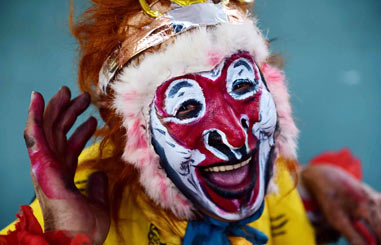
Although the term "intangible cultural heritage" often denotes the need for traditions to be safeguarded, an increasing number of China's intangible cultural heritages are doing well by metamorphosing into fashionable items.
Huang Ronghua, a dyer using natural materials, has not only worked with many fashion designers and clothing companies to adopt traditional dyeing of the latest fashions, but also started his own brand - Caomuqing.
Related: Place names abound as Su Shi's legacy
A silk scarf dyed by Huang sells for 1,400 yuan ($221). His products also include shirts, bags and pillows. At the Second Expo of Chinese Intangible Cultural Heritage, which concluded on Monday in Zaozhuang, Shandong province, Huang's products were sold out.
"You can find the colors of unearthed relics from more than 1,000 years ago still well preserved," says Huang, from Wuhan, Hubei province.
The materials that Huang uses include pomegranate skins, woad roots and various grasses and flowers.
Huang, who used to be an engineer at the Textile Industry Scientific Research Institute of Hubei Province and worked for many textile factories, developed an interest in natural-material dyeing in the early 1990s.
In April, fashion designer Chu Yan's works with Huang's natural dyeing were shown at China Fashion Week in Beijing, which was well received because of the vintage flavor that the dyeing endows the dresses with.
During the five-day Second Expo of Chinese Intangible Cultural Heritage, Huang demonstrated his dyeing processes every day.
Related: The art of China watching
More than 1,800 inheritors of China's various intangible cultural heritages from all over the country took part in the expo, representing 767 items.
Huang Ou, president of Shangzhengtang, a company that specializes in the production of incense, says that he attended the expo to promote the art of Chinese incense, which is now reviving.
In ancient times, incense made from agarwood was used to soothe the mind and cure some diseases. It was also widely used in various religious rituals.
For centuries, incense made from the agarwood of Dongguan, Guangdong province, has been considered to be the best in China.
Having grown up in Dongguan and a family tradition of the art of Chinese incense, Huang burns incense at home on the first and 15th of every lunar month as a family ritual.
Huang started Shangzhengtang company six years ago, and it has been prosperous due to a growing number of urban people using incense as a regulator in their busy life.
A gram of Huang's incense products costs from 100 yuan to 40,000 yuan, depending on the quality. He says all his products are pre-ordered, and he can hardly meet the demand of his customers, who are mostly intellectuals, business people and civil servants in big cities.
Huang expects the incense market to grow much bigger in China, but on condition the government adopts favorable policies for the planting of agarwood trees. As a lot of land in Dongguan has been contaminated with chemicals, it is now hard to find suitable land for agarwood trees that can produce the highest-quality incense.
Initiated by the Ministry of Culture, the first Expo of Chinese Intangible Cultural Heritage was held in 2010 in Ji'nan, capital city of Shandong province.
This year, the expo took place at Zaozhuang's Ancient Town of Tai'erzhuang, a replica of an old town on the Beijing-Hangzhou Grand Canal that was ruined during the War of Resistance against Japanese Aggression (1937-45).
In an effort to boost tourism, the government of Zaozhuang tries to make the Ancient Town of Tai'erzhuang a base of traditional Chinese culture, and has so far attracted inheritors of 108 items of China's intangible cultural heritage to operate stores or exhibition spaces in the town.
In recent years, China has encouraged the safeguarding of its intangible cultural heritage in a number of ways. A system of intangible cultural heritage ranging from the national level to the county level has been established, with the national list currently comprising 1,219 items.
muqian@chinadaily.com.cn
|
|
|
|
|
|
|
|

Copyright 1995 - . All rights reserved. The content (including but not limited to text, photo, multimedia information, etc) published in this site belongs to China Daily Information Co (CDIC). Without written authorization from CDIC, such content shall not be republished or used in any form. Note: Browsers with 1024*768 or higher resolution are suggested for this site.
License for publishing multimedia online 0108263 Registration Number: 130349 




 Raymond Zhou:
 Pauline D Loh:
 Hot Pot
 Eco China
 China Dream
 China Face