|
|
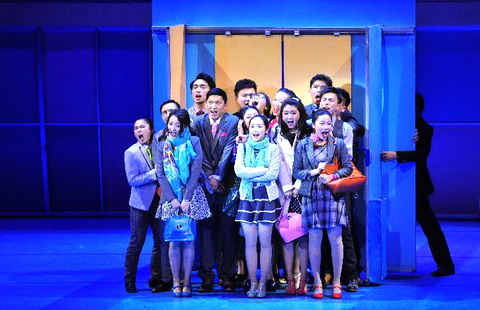
[Photo by Cai Meng/China Daily] |
If asked, most Chinese would say they've seldom tried shaoniao, or roasted bird. But, in Japan, the two Chinese characters pronounced as yakitori mean chicken skewers. The skewers, of course, are equally popular in both nations.
Not just in Japan, hanzi (Chinese characters) are also used in South Korea and Vietnam as important tools for cross-culture communication.
In April 2014, media from China, Japan and South Korea jointly held a forum in eastern China's Jiangsu province, where a chart of about 800 Chinese characters was presented to the public.
The list of the "most commonly used" Chinese characters unveiled at the Northeast Asia Trilateral forum in Yangzhou includes entries such as kong (sky), mi (rice), mu (mother) and xue (blood).
Zhao Tong, an associate professor at the School of Liberal Arts, Renmin University, is a member of the research group that selected the characters. According to him, consideration was given to "commonality and frequency of use" of the characters while picking them.
"We compared the most authoritative materials in China, Japan and South Korea, and came up with the most commonly used characters that share the same usage in the three countries," he says.
It took the group nearly four years of deliberations to prepare the list, before the final draft was announced in 2013 at a similar trilateral meeting in Hokkaido, Japan.
"Chinese characters were disseminated in the Korean Peninsula during the Three Kingdoms (AD 220-280), and were used until 1970, when the Republic of Korea started promulgating the present official alphabet hangul," says Jin Haiying, a Renmin University lecturer, who compared Chinese characters used in China and South Korea and assisted the research group.
Many Chinese characters are used in South Korea to date, she says, adding that South Koreans have their names registered in such characters. "Many newspapers and books on the law also use Chinese characters."
Compared with South Korea, Japan, on the other hand, uses Chinese characters more broadly and frequently, even if some Chinese and Japanese words are written in similar ways but often with different meanings.
In addition, Japanese words such as dingshi (box meal) and liaoli (cuisine) are widely accepted in China.
"Most customers come to our restaurant with basic knowledge of Japanese cuisine, so they don't have trouble understanding the menu in Japanese, ... say, cishen (raw fish, sashimi), for instance," says Zhou Tong, owner of the Japanese restaurant Yotsuba, in Beijing's Sanlitun area.
The only problem the customers often encounter is with the pronunciation of some Japanese words, he says.
Asked if the restaurant will put the Most Commonly Used 800 Chinese Characters into use, Zhou hesitates, saying: "I understand the idea, but we have to see if the chart is practical enough."
"Historically, Chinese traditions have strongly influenced the cultural development in South Korea and Japan. Nowadays, however, the influence has moved from unilateral to mutual," says Jin.
"The popularity of Korean TV series and Japanese animation shows us the impact of our neighbors' unique cultures."
She says that in the era of globalization, sharing language benefits everyone.
|
|
|
|
|
|
|
|

Copyright 1995 - . All rights reserved. The content (including but not limited to text, photo, multimedia information, etc) published in this site belongs to China Daily Information Co (CDIC). Without written authorization from CDIC, such content shall not be republished or used in any form. Note: Browsers with 1024*768 or higher resolution are suggested for this site.
License for publishing multimedia online 0108263 Registration Number: 130349 









 Raymond Zhou:
 Pauline D Loh:
 Hot Pot
 Eco China
 China Dream
 China Face