|
|
|
||||||
 |
|
|

|
|||||
| Home | BizChina | Newsphoto | Cartoon | LanguageTips |  |
Metrolife | DragonKids | SMS | Edu | ||||||||||||||||||||||||||||||||
|
|
|
|
|
|
| news... ... | |
|
|
|
|
|
|
|
|
|
|
|
|
|
|
|||||||||||
|
|
|
|
|
Focus on... ... | |||||||||||||||
|
|
IMF ponders crisis prevention at meeting
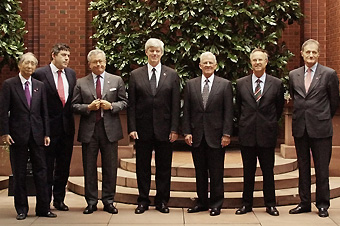
The global lender's policy-setting International Monetary and Financial Committee, comprising finance ministers from rich countries and the developing world, met on Saturday to set the IMF's agenda for the coming six months. Top of the agenda was how best to shore up the nascent global economic recovery, which has not taken hold as quickly or as strongly as the IMF had hoped just a few months ago. The IMF called on rich nations to rebuild confidence shaken by plunging stock markets, and urged Europe and Japan to speed economic reforms to bolster their long-term growth prospects. "We meet here in Washington at a testing time for the world economy, with 20 countries accounting for half the world's output having been at some point in the last year or this year in recession," Gordon Brown, chairman of the IMFC and British finance minister, said at a news briefing after the meeting. "Aware ever more of our interdependence, we are now more than ever aware that it is only by each country taking necessary action that we shall secure the economic growth we wish to see," Brown said at a news briefing. Earlier at the meeting, U.S. Treasury Secretary O'Neill said, "North America continues to be the engine of global recovery," and others must do more to bolster prospects. The IMFC called on Europe to reform labor and product markets and for Japan to tackle its banking and corporate problems, where, "monetary easing should help end deflation." But with key Latin American nations embroiled in economic turmoil and others there looking increasingly vulnerable, crisis prevention took center stage at the meeting. Meanwhile outside the meetings, peaceful protesters gathered. The rag-tag bunch, who oppose everything from the World Bank's involvement in oil and gas projects to the need for more debt relief for poor countries, numbered only a few thousand after police depleted their ranks with more than 600 arrests in scattered street skirmishes on Friday. The number of protesters paled in comparison to the crowds in April 2000, when tens of thousands of anti-globalization demonstrators turned the streets near the IMF's headquarters into something of a siege zone. On Saturday the closest the thousands of protesters got to the IMF was a few blocks away where they rallied for much of the afternoon, causing minor disruption to city traffic. BANKRUPTCY COURT Perhaps the single most important development on Saturday was the IMFC charging the IMF to come up with a plan by April to pave the way for setting up some sort of international bankruptcy court to deal with what should happen if a country defaults on its debts. The IMFC told the IMF to, "develop for consideration ... a concrete proposal for a statutory sovereign debt restructuring mechanism to be considered by the membership." The issue has been spurred by the economic collapse and subsequent default of Argentina -- the former Wall Street darling and erstwhile poster child of IMF reforms. And with Brazil hit by investor worries that a $250 billion debt default is possible, there is finally agreement that something must be done to avoid a repeat of the Argentine debacle. The IMF hopes a new bankruptcy court will make the process of default more predictable, less painful and eventually act as a steadying influence on emerging market investors. "This is part of an integrated process for better crisis prevention," IMF Managing Director Horst Koehler said. And, hoping to allay Wall Street opposition, he added, "This ... will not undermine the credit culture in the global economy. It is a last resort." The fund's approach complements another plan endorsed on Friday by the Group of Seven industrialized nations -- the United States, Japan, Germany, Britain, Canada, France and Italy. The G7 said on Friday all emerging market bonds should now include so-called collective action clauses detailing what should be done if a default occurs. While rich countries support the approach of both collective action clauses and an international bankruptcy court, not everyone agrees. The G24, a group of top emerging market economies, said on Friday it was "open-minded" about the G7 plan but "skeptical" about the IMF's idea. Wall Street too opposes the IMF's plans. Mexico, a key emerging market because of its investment-grade credit rating, opposes the IMF's approach. The nation is more open to collective-action clauses, but Finance Minister Francisco Gil Diaz said on Saturday he doesn't see, "either lenders or borrowers seriously considering them." Nevertheless, the fund is convinced an international bankruptcy court will help its broader crisis-prevention efforts to stop problems before they happen. The discussion comes as Argentina's economy flounders in a state of collapse after nine months of failed talks to restart aid. Meanwhile Brazil is mired in a crisis of confidence ahead of October presidential elections, which prompted the IMF to fork out a record $30 billion bailout earlier this month. Koehler dismissed market fears that Brazil's crisis will end in a debt restructuring, saying, "Brazil will come out of this situation without a debt restructuring." But even while the IMF showered Brazil with praise in recent days, its real currency has plumbed new lows. This latest summit has been notable for increased impatience about what many, including the heads of the IMF and World Bank, view as the hypocrisy of rich nations' trade policies and low aid levels. Brown said there was now a "new deal for the world economy" where rich nations would increase aid and investment in developing nations in return for reforms there. But even as he made that statement, he urged donor nations to come through "urgently" with $1 billion to keep an already-promised debt relief plan for the world's poorest nations afloat.
|
|
|
|
|
||||||||||||||
|
|
|
|
|
||||||||||||||||
|
|
|
|
|
||||||||||||||||
|
|
|
|
|
||||||||||||||||
|
|
|
|
|
.contact us |.about us |
|
|
|
|
|
|
|
|
| Copyright By chinadaily.com.cn. All rights reserved |