Food fight
 |
|
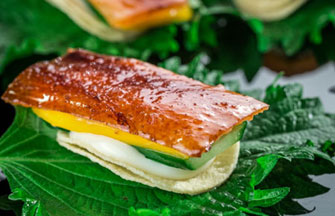
A team of chefs is busy in group competition of the 2012 World Master Chef Championship in Jiangyin, Jiangsu province. Photos by Ye Jun / China Daily |
An international competition crowns kings of the kitchen, while also drawing record crowds with its carnival-like atmosphere. Ye Jun reports in Jiangyin, Jiangsu province.
A recent international cooking competition in China's richest village became a food carnival for both chefs and visitors. More than 350 chefs from China and overseas came to Huaxi village in Jiangyin, Jiangsu province, to attend the Lee Kum Kee Cup 2012 World Master Chef Championship from May 26-28. They came from 33 countries, including the United States, Canada, Russia, Germany, South Korea, Singapore and China. The contestants formed 24 overseas and 18 Chinese teams. More than 160 chefs attended individual competitions. The number of observers and contestants was a record-breaking 1,000 plus.
Every team in the group competition had four chefs.
They were required to make three main courses, a soup and dim sum within three and a half hours. They had 135 minutes to complete the first dish. Afterward, another dish had to come out every 15 minutes.
Individual contestants, on the other hand, were assigned to create two hot dishes, or two dim sums, within 90 minutes.
Sam Leung, executive chef with Dynasty Seafood Restaurant in Vancouver, says making 10 helpings of two hot dishes in an hour and a half is already a challenge. A time-keeping mistake meant he had just an hour to finish everything.
"I've done better than I expected," he says.
"In that sense, I have already won. But I'm happy to discover my potential."

He made two dishes. One, created with Vietnamese-style prawn, was called "butterflies love flowers". The other was a beef dish called "autumn on the rocky mountain".
He brought marble from Canada to use as a "mountain" and carved a yellow and a red piece of pumpkin to resemble maple leaves. Then, he cut beef into thin slices, which he used to wrap Chinese yam to sautee.
All contestants had to use the same ingredients - beef and prawns, 16 side ingredients and 60 seasonings, most of which came from the sponsor, Lee Kum Kee. They also have to prepare dishes on woks and stoves they've never used before.
Chefs are only allowed to bring their own knives and plates, says Li Yaoyun, director of the International Exchange Association of Renowned Chinese Cuisine Chefs, the championship's organizer.
"This made the competition more difficult but also fairer," Li says.
Li says the competition was a great test of basic cooking skills and chefs' ability to think on their feet.
Contestants had to use different cooking methods, ingredients and knife work for every dish.
The 14 judges were from the United States, Japan, Australia, South Korea, Singapore and China. Among them were the host of the award-wining US TV program Yan Can Cook, Martin Yan, and Chinese master Zhao Renliang, who specializes in Shanghai cuisine.
"We hope the competition raises the bar and facilitates exchange in the area of Chinese cuisine," Li says.
Contestants paid great attention to presentation.
The team from Hubei's provincial capital Wuhan, which won the mainland category, presented beautiful prawns floating in clear soup.
Jade Garden of Hong Kong, which took the top spot in the non-mainland category, shaped their pastries like pipa (a Chinese lute) placed on lotus leaves around a white lotus bloom.
Locals and chefs snapped photos of contestants' dishes.
British Columbia Chef's Association member Winnie Lam says she could tell just by looking at one dish that the chef had an international background.
"When a chef sticks to a circle, his cooking usually deteriorates," she says.
"But after you see around you and learn from others, it becomes easy for you to improve. That's why we want to be here."
Lam and Leung are among 10 Canadian chefs - six of whom are Chinese - at the competition. They're members of the British Columbia Chef's Association.
Korean chef Cheng Shih-chun represents a chef's association in Pusan's Gyeongsangnam-do. He led seven chefs from the region to attend group and individual competitions.
"In Korea, Chinese and Western restaurants are the minority," says Cheng, who owns the Summer Palace Chinese Restaurant.
"We are here to learn and exchange."
Macao's Catering Labor Union director Sou Wai Leong says eight chefs from Macao attended.
Two Macao chefs won gold in the hot dish and pastry categories.
"(Mainland) chefs are adopting Western ways of presentation and Western ingredients, which is more economical," Suo says.
"But in Macao, we don't encourage adopting Western style."
Suo says he was satisfied with the facilities.
The contest was staged in a huge hall in a former factory.
The upside is that there was plenty of space - the ceiling was 9 meters high.
The downside was that it was a bit dark and utilitarian.
But, ultimately, the spaciousness enabled organizers to set up a food and catering facility exhibition and a sales area of traditional Jiangyin specialties, while hosting a snack food festival of regional snacks made on the spot. The exhibition area featured 120 stands.
The snack food area sustained local visitors. The most popular stands served Xinjiang barbecue, Inner Mongolian roasted meat, Hunanese stinky tofu and Taiwan treats. Ultimately, the snack zone proved a huge draw that brought crowds to the contest.
Deputy village chief of Huaxi village Zhou Li says the competition tested the village's ability to receive guests, while also improving local chefs' skills.
Tourism is a huge industry for the village. About 2 million visitors flock to Huaxi to see China's richest village every year. In 2011, the village of 30,000 earned a total of 50 billion yuan ($7.85 billion).
Zhou says Huaxi can host 10,000 overnight visitors and 20,000 diners a day.
Contestants stayed in the 72-storey, 328-meter-high Long Wish Hotel, built with an investment of 10 million yuan ($1.57 million) by each family.
Lee Kum Kee Cup 2012 World Master Chef Championship is the event's second session. It was staged in Taipei last year and will head to Hong Kong next year.
Leung says his dream is to bring Chinese cuisine to the mainstream Canada.
"We hope foreigners will learn that Chinese cuisine has culture and class," he says.
"It can be artistic and picturesque. China's rich culinary culture is the root of Chinese cuisine overseas. If foreigners understand that, it will lift Chinese food ... (and) the status of Chinese chefs overseas."
Contact the writer at yejun@chinadaily.com.cn