Roast duck renaissance
 |
|
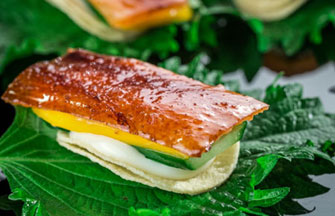
Beijing Bianyifang Roast Duck Restaurant specializes in shuxiangya (vegetarian aroma duck). Provided to China Daily |
What makes one Peking duck stand out from the next? It's all in the roasting, as Ye Jun finds out from the oldest restaurant still serving this capital city signature dish.
It is not easy preserving an age-old culinary tradition while balancing the need to cater to modern taste buds. This is especially so when the method you are talking about has been around for nearly 600 years.
Beijing Bianyifang Roast Duck Restaurant was founded in 1416, more than 400 years before Quanjude, arguably the city's most recognized name for roast duck. Quanjude was established in 1864.
Bianyifang is known for guarding its traditional closed-oven roasting technique, which Quanjude had abandoned in favor for open-oven roasting - to cook the ducks faster and to make it easier for the chefs. Since the 1970s, Quanjude had expanded as an epicurean phenomenon, and the open-oven technique became more prevalent in Beijing.
Bianyifang was relegated to the sidelines.
So, when Beijing chef Sun Lixin joined Beijing Bianyifang Roast Duck Group 10 years ago, he found some major problems with its closed-oven roast duck.
"The duck tasted greasy. When it turned cold, there was an unpleasant smell," he says. "Its nutritional value wasn't so balanced, because there weren't many vegetables in the dish. The green onion served with the duck left a bad taste in the mouth."
Sun, deputy general manager and executive chef of Bianyifang, says there were other reasons why Bianyifang was left by the wayside as Quanjude enjoyed its glory days.
"In the 1970s, Peking roast duck became part of China's foreign diplomacy, along with table-tennis," Sun says.
"At the time, Qianmen Quanjude was a big restaurant on the main street, while Bianyifang was a small eatery inside a hutong. So the government chose Quanjude as the place to host foreign guests, giving it a lot of publicity and support."
Quanjude is managed by the Beijing municipal government, while Bianyifang is managed by the Dongcheng district government - which may also have influenced their respective development.
But, over the years, Sun and his colleagues worked hard to overcome the disadvantages, giving the closed-oven roast duck a makeover and a healthy image.
In 2005, Sun invented shuxiangya (vegetable aroma duck), which later received a patent. "Before we roast the duck, we soak it in vegetable juices for five to six hours, and we pair the roasted duck with vegetables when we serve it," he says.

Preparing a Peking roast duck takes at least four steps: preparing the duck, pumping air beneath the skin, drying and roasting.
Sun added a step before roasting - soaking the 3-kg duck in pure juice extracted from 10 types of vegetables.
The vegetable juice, being alkaline, eliminates the pungency of the duck but also reduces the duck fat beneath the skin.
At the same time, the skin retains the fragrance and tempting luster of traditional roast duck.
Sun has kept to traditional closed-oven roasting where the brick oven is preheated for five hours before 10-20 ducks are put inside and roasted for 45 minutes at about 200 C.
There is no direct contact between the fire and the duck, which reduces the risks of carcinogens from carbon, Sun says.
The ducks are also sliced differently. At Bianyifang, they are slivered in the shape of an "elephant eye", with the skin and meat together so diners can enjoy both the tender meat and fragrant, crisp skin.
Bianyifang's duck is served with two kinds of pancakes - red and green. The red one is colored with carrot juice while the green has celery juice added. Side dishes include turnip sprouts, toon sprouts, lettuce and mint leaves, without the traditional shredded green onions.
Sun says that when he joined Bianyifang, the restaurant group was at its lowest point. "Traditional dishes were not passed down nor protected sufficiently. Dishes became out of date. The service and environment fell behind the times.
Traditional dishes no longer tasted good," Sun says.
He tried to carry out standardization in the kitchen but found himself up against a wall of stubborn traditions in a very old State-owned enterprise. It was difficult even to change something as trivial as the wok size or scoop.
"It was typical to think 'we are the big brothers' and disregard customers' needs," he says. "The most difficult part was not preserving cooking techniques but, rather, shifting conceptions."
He worked hard to bring in new talent, such as chefs who had worked in big hotels, while he introduced innovative dishes and improved service standards.
Sun has a broad spectrum of culinary influences. He studied under a Sichuan cuisine master in his early days but later also learned Cantonese, Zhejiang, Shandong, Hunan and Beijing cooking.
His knowledge of Cantonese cuisine, with its beautiful presentation and healthy concepts, is a basis for his innovation.
The rest of his inspiration comes from combining traditional cooking techniques with modern ingredients and presentation.
His efforts have paid off, and Bianyifang is again enjoying an excellent reputation.
It now has 17 branches in Beijing and closed-oven roasting has been adopted by some high-end hotels because it is healthier.
Sun says that although they source the same ducks as Quanjude, theirs are produced at a higher cost and sold for less.
"Many dishes are popular only for a period of time. But Peking roast duck is an all-time dish representative of China," Sun says.
"I hope my 'vegetable aroma duck', with its healthy concept, can be passed on to future generations.
"What the diners want is something practical and realistic. Techniques such as molecular gastronomy can only be used for special effects."
Sun is from the first batch of national-level cuisine masters named in 1999 and was awarded among the Top 10 Chinese Chefs by the Ministry of Commerce in 2006.
Early in June, Beijing Bianyifang Roast Duck Group celebrated the 10th anniversary of its founding and the 596th anniversary of the brand name.
To celebrate the occasion, the group honored four chefs as the guardians of its culinary treasures.
As executive chef, Sun Lixin was given a "frying pan and frying ladle" made of cloisonne.
Chef Bai Yongming, closed-oven roast duck specialist, was given a "roast duck pole".
Shaomai (steamed pork dumpling) specialist Wu Huaxia received a shaomai making zouchui (a rolling pin).
Traditional pastry master Zhao Haixia also received a rolling pin.
Bianyifang's closed-oven roast duck technique, as well as the shaomai making skills of its sister restaurant Du Yi Chu, are recognized as China's national cultural intangible heritage.