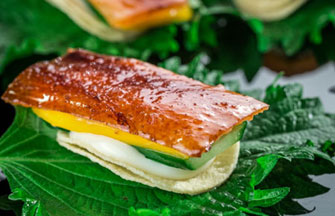
Water on your plate
 |
|
[Photo by Li Feng and Zhang Chengliang/China Daily] |
When Nathan Lawes and Lingmei Wang visit Chinese schools, they like to show children a steak and a tomato. Which item, they ask, requires the most water to produce?
The kids usually point to the obvious answer, the juicy tomato.
Wrong, grins Lawes, a young Canadian volunteer who presents educational programs for a global NGO called Thirst 4 Water.
On a commercial farm it takes about three years before a cow can be slaughtered to produce about 200 kilograms of boneless beef. During its life, the animal will eat nearly 1,300 kilograms of grains such as wheat and barley, and nearly 7,200 kg of grass, hay and other roughage. The production of all that grain and roughage requires 3,060,000 liters of water. Add to that the 24,000 liters of water the cow actually drinks in three years, plus 7,000 liters needed to service the farmhouse and slaughtering operations, and a total 3,091,000 liters of water is consumed to produce that 200 kg of meat, according to industry reports.
Put another way, that means 15,400 liters of water is needed to produce 1 kg of boneless beef. (That's the equivalent of an 8-by-40-meter wall of 1-liter water bottles.)
"When we shower," says Wang, "we can see water going down the drain and we have sense of how much water we could waste with a long shower. But when you eat, you don't see the water needed to grow and transport your food."
Being aware of the "invisible water" that goes into everything from cooking to laundry-researchers say food represents 3,496 liters of water that the average person in the United States "consumes" every day-is the first step toward solving a global problem.
"We're not expecting people to give up meat," says Lawes. "That's not going to happen. But if we recognize the problem we can change some of the habits that cause it."
China's government is keenly aware of the challenge, and water conservation is aggressively imbedded in the recently unveiled the 13th Five-Year Plan (2016-2020). Officials have predicted Beijing could run out of water in less than 50 years, and other studies note that 93 percent of China's industry depends on water.
Food is a "massive" part of the equation, Lawes and Wang say, insisting we must gradually but steadily change our eating habits as well as the most water-intensive food production processes.
People in developing countries have traditionally eaten less meat than their more affluent neighbors. But as incomes have risen in China and elsewhere, so has the appetite for animals. That means we're using more water to grow grain to feed livestock instead of people, activists say, and that's just one worrying trend.
China's green-minded planners are so concerned that they are pushing policies once unthinkable: Instead of a constant push to procure more rice, for example, they are trying to convince Chinese to eat less of it. Potatoes need much less precious water to grow than rice does-so agriculture officials want to see potatoes emerge as a staple starch, used for flour and noodles as well as french fries. They are also promoting tomatoes as a crop, which can be sustainably grown in greenhouses with recirculated water.
Some high-profile corporations are into the water-saving act, too. Hotels have long urged visitors to use sheets and bath towels for more than one day to save laundering, and now they are paying more attention to water's impact on food. Green technology drives kitchens and plumbing in establishments like the Nuo and Hotel Eclat. Global giants like the Fairmont chain develop their own food-supply chains to ensure not only food safety but sustainable growing practices. Nuo and the Fairmont hotels have even established their own farms in China to ensure sustainable practices, including water conservation.
Levi Strauss CEO Chip Bergh, meanwhile, has famously said he only needs to wash his jeans once a year.
"Better technologies and habits about laundry, flushing toilets and brushing teeth are important," says Thirst 4 Water's Lawes at a recent Beijing Foodies dinner. "But if we could reduce meat consumption, that would reduce water use exponentially."
That doesn't mean we all become vegetarians, he says. One habit adjustment he points to is Meatless Mondays, a concept embraced by celebrities like fashion guru Stella McCartney. Lawes notes that the Canadian International School in Beijing adopted Meatless Mondays for one year.
If Earth Day, which we celebrate on Friday, could inspire more people to appreciate a plate of noodles with a little meat sauce as often as a big steak or a hamburger, that's a step forward, too.
Contact the writer at michaelpeters@chinadaily.com.cn