Railway facilitates lives in Tibet
The Qinghai-Tibet Railway has passed safety and environmental tests and brought economic prosperity to formerly inaccessible Tibetan areas.
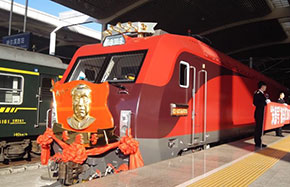
Around 550 kilometers of the 1,956-km railway on the world's highest plateau is laid on permafrost. Linking Xining, capital of Qinghai province, and Lhasa, capital of the Tibet autonomous region, it has transported more than 52 million people and 240 million metric tons of goods since it became fully operational in July 2006.
In 2011, Tibet received 8.6 million tourists, up from 1.8 million visitors in 2005. Tibet's tourism industry generated 9.7 billion yuan ($1.53 billion) in revenue in 2011, five times the amount in 2005.
Qinghai attracted 60 million tourists, bringing revenue of 35 billion yuan, in the past six years.
Tibetan nomads and farmers are benefiting from businesses such as home inns, restaurants and tour guide services. More than 236,000 people work for the tourism industry in 1,363 companies in Tibet.
Pasang Dondrub, a Lhasa resident, makes a living by accompanying tourists during their tours of Tibet. His business has boomed because of the increasing number of tourists brought by the railway.
He earned 60,000 yuan from May to October 2011, three times his yearly income before 2006. With 20 years' experience, he is frequently recommended to new clients, and sometimes the number of calls is overwhelming.
His nephews, Purbunamgyl, Dradul and Gunganamgyl, have joined the car rental business and each earned about 50,000 yuan during the six-month peak season last year.
They often pick up guests at Lhasa Railway Station. "Each time I see a train arriving, I tell myself the railway has brought me friends from across the country and a good income," Pasang Dondrub said.
Purbu Dondrub, head of Liuwu village, which is separated from Lhasa by a river, said villagers used to take ferries or climb mountains to go to the city. Now the village is included in the new Liuwu district where Lhasa Railway Station is located. Participating in the construction of both the station and the new district, Purbu Dondrub said his household income has jumped to 50,000 yuan from 2,000 yuan before 2006.
The railway also facilitates communication and exchange of goods between Tibet and other parts of China. Specialty goods, such as barley wine, mineral water and yak meat, as well as Tibetan medicine, incense and carpets, are popular outside the region.
"The railway ended the era of supply shortages in Tibet," said Liang Chunming, a solar power businessman in Tibet.
Liang, from Xi'an, Shaanxi province, used to worry about shipping goods to Tibet. Without the railway line, shipment could only be done on a small scale and took a long time.
Since the railway was completed, transportation costs and the damage rate have been reduced and the sales volume significantly increased, allowing his business to continue to boom, he said.
Geleg, 23, from Lhasa's rural suburbs, is a third-year student at the University of Science and Technology Beijing. After a summer vacation at home, he took the train back to school on Aug 13, a 42-hour trip costing 180 yuan at the student discount rate.
Ten years ago, it took him more than four days when he traveled to study in East China's Zhejiang province. His father drove a truck and dropped him off in Lhasa, where he took a bus to the airport and flew to Chengdu, Sichuan province. He then traveled by train to Zhejiang province.
For years, he did not go back home during the winter and summer vacations because he could not afford such trips.
"The Qinghai-Tibet Railway has greatly helped students like me," Geleg said.
During the construction of the railway, planners and construction companies worked hard to protect the plateau's fragile ecology, biodiversity and rich ethnic traditions.
To ensure the normal migration of wild animals, 33 special passages were built along the railway. All passenger trains leaving or entering Tibet are equipped with an advanced system to collect waste and sewage to prevent pollution.
Contact the writers at liyao@chinadaily.com.cn and daqiong@chinadaily.com.cn