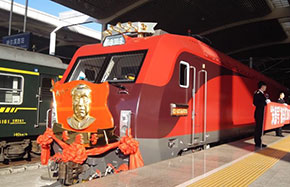
Once a dream, now rail link is a reality
Addis Ababa-Djibouti Railway attracts attention across Africa and beyond as prospect of connecting capitals comes closer
The Addis Ababa-Djibouti Railway, which connects the capital cities of Ethiopia and Djibouti, was officially inaugurated on Oct 5.
Constructed by China Railway Group and China Civil Engineering Construction Corp, a subsidiary of CRCC, the railway is Africa's first cross-border standard-gauge rail line and also the first railway using a complete set of Chinese standards, technology and equipment outside China.
Over the next six years, the railway's operation and maintenance will executed by a locally registered Chinese subsidiary, to allow time to train enough local people to take over.
Chinese enterprises' "going out" model has transformed from financing and construction contracting to the operation of a whole industry chain.
The Addis Ababa-Djibouti Railway, stretching for 752.7 kilometers, was built with a total investment about $4 billion (3.6 billion euros; 3.2 billion).
The line slashes travel time between Addis Ababa and Djibouti from seven days by road to about 10 hours by rail. It sharply cuts the logistic costs of imports and exports and is expected to boost social, financial and industrial exchanges between the two countries. The railway's inauguration is considered a milestone in the African countries' road to industrialization.
The railway is the second cross-border line constructed by Chinese enterprises in Africa: the Tanzania-Zambia Railway was first.
However, unlike in the previous projects, Chinese companies involved in the Addis Ababa-Djibouti line were responsible for both project construction and subsequent operating management over the coming six-year transition period. During that time, the Chinese company will help educate and train local technicians and management professionals.
Considering the technology and intellectual capacity of Ethiopia and Djibouti, China's transformation from construction mode to management will not only sustain rail operations but also help expand the two countries' capacity. Transforming from the mode of giving a fish to teaching how to fish, the new model will guarantee railway safety while producing greater social and economic benefits. The training will provide the countries enough talent to sustain future operations.
So far, the Addis Ababa-Djibouti Railway has created 3,000 jobs for local people, and it is expected to create another 10,000 when its operation is in full swing. These people will be the first generation to drive the development of modern electrified rails in Ethiopia and Djibouti.
Some Ethiopian officials see the new railway as a game-changing project, as it is expected to reinforce the development of industrial parks, special economic zones and other industrial chains along the route, gradually emerging as an economic belt.
China Civil Engineering Construction Corp, for example, has been actively involved in the construction of industrial parks, ports and real estate, as well as businesses involved in manufacturing and logistics along the route.
Infrastructure construction, including ports, airports and the development of industrial zones, will in the end become a great driving engine to the countries' industrialization and modernization.
In recent years, Ethiopia has been in the front line in Africa in terms of infrastructure construction, industrialization and economic growth. The opening of the railroad and the prospect of the associated economic belt have attracted the attention of Africa and beyond.
It is reported that a number of governments of such countries as Uganda, Rwanda, South Sudan, Togo and Kenya have made special trips to study the Addis Ababa-Djibouti Railway in the hope of learning from that experience and upgrading their own railway plans. We have every reason to believe that the prospect of connecting the African capitals with steel rails will no longer be a dream.
The author is a senior researcher at the Charhar Institute and researcher at the West Asia and Africa Studies Institute of the China Academy of Social Sciences. The views do not necessarily reflect those of China Daily.