The hardware technology of electronic product s has become more sophisticated and products of the same type have similar performance and functions for consumer. Therefore, design and graphic user interface (GUI) design have played the leading roles in the competition stage for various electronic products. The reason why iPhones and iPads have won worldwide popularity mainly lies in their unique touch mode in GUI design. Companies have invested a lot of human and financial resources to make the GUIs more user-friendly and to relieve the users' cognitive load so as to enhance the performance and competitiveness of the product.
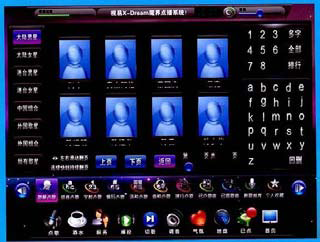
The most common GUIs can be divided into two types: the traditional mouse and keyboard input GUI and the more common touch mode GUI. There is no substantive difference between them except for the input method. The application programs are both operated by touching icons. Touch mode GUI is widely used in portable electronic devices, such as a hand-held tablet PC, smartphone, etc. GUI is mainly composed of elements such as windows, desktops, icons and menus, while icons and its layout are the core parts. The icons themselves are highly instructive and indicative; they are symbols of the functions which can be performed by users. Special attention should be paid to ensure that though users can input programs by touching icons and operate related programs, the core of the operation is achieved by joint of supporting programs and application programs, while users' instruction are issued in the form of clicking the icons or touching the screen.

GUIs, as a competitive tool for enterprises, reflect designers' creative intelligence and concurrently play a crucial role in competition for consumers, and therefore should be protected by law.
The protection environment of GUI
Theoretically, it is generally believed that GUIs should be protected by the Copyright Law or by the Patent Law.
Copyright Law protection
Chinese Copyright Law provides protection of many subject matters, including works of fine art and compilation works. Works of fine art refer to two or three dimensional works created in lines, colors or other mediums which, when being viewed, impart aesthetic effects, such as paintings, works of calligraphy, sculptures, etc. Compilation works refer to works which are complied of certain works, fragments of works or the data or other materials not constituting a work, and selection or layout of the contents of which embody the original creation. In essence, a product's GUI could be viewed as a work of fine art or as a compilation work.
China has neither legislation nor judicial precedent concluding that GUIs are covered by copyright protection, considered a work of fine art or a compilation work.Shenzhen TP-LINK Technologies Co., Ltd. (TP-LINK) v. Shenzhen Tenda Technology Co., Ltd (Tenda)is China's first computer GUI copyright infringement case.

The first instance court stated that the alleged infringing GUI of the wireless router was a compilation work while the second instance court held the contrary and reversed the decision of the first instance court for three reasons. The first reason was that the function menus and buttons, as elements of GUI, indicated corresponding functions, which were parts of operational methods and were purely functional. In turn, since the Chinese copyright laws protect creative expressions, but not ideas, operational methods or mathematics concept, and therefore these operational methods were not protected under Chinese copyright laws. The second reason was that the dialog boxes, windows etc. displayed after running the related orders were common elements for designers when designing the program of routers. This intermittent display meant they could not meet the creativeness requirement for compilation works, therefore were ineligible for copyright protection. The third and final reason was the Court's opinion that the GUI could not be considered as a compilation work because the view of the GUI as a whole (the selections, arrangements and layouts of the elements) was fairly simple and not creative enough to be distinguished from other GUIs for wireless routers. After reading the verdict delivered by the second instance court carefully, it could be concluded that the second instance court elaborated on two aspects why the alleged infringing GUI was ineligible for copyright protection: on the one hand, the constituent elements of GUI alone were not works eligible for the Copyright Law protection; on the other hand, the combination of these elements didn't meet the requirements of compilation works.

It is worth noting that the verdicts reached by the two instance courts on the GUI were totally opposite. The independent creation requirements of a work, or the ambiguity and subjective of the assessment criteria for independent creation in China lead to GUI protection under the Copyright Law must be judged according to individual circumstance. Though the assessment criteria for independent creation are common issues in copyright protection, they are more tricky issues in GUI protection. The reasons are stated below: in practice, independent creation should present a certain level of creativity, however, it is uncertain as to how high it should be. The individual elements of different GUIs are similar or even identical; the differences lie in the combinations and arrangements of the elements which should take user's requirements into account, especially the functionality and user-friendliness. This will cause troubles when assessing independent creation.

