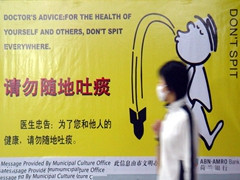
Efforts needed to preserve the environment, develop the economy and provide a better safety network in rural areas
A US colleague of mine once told me of a TV program he had seen, which showed the loss of the Chinese countryside to urban development. "I don't get it," he said shaking his head, "it was so beautiful out there. Why would they try to destroy it to build towns?"
However, such sentiments ring hollow to most Chinese, as the word "countryside" (nongcun) is so negatively value laden that few people see anything positive in it. It is difficult to get city folks to appreciate what is good about the countryside.
Those of us who grew up in the countryside are often nostalgic for an idyllic, rural past. We recall days when we ran carefree in the clover fields and mountains filled with rhododendron bushes and pine needles! Nights when we gazed into a crystal-clear starry night, lying on a bamboo bed out in the fields, wrapped in the aroma of mosquito-repelling wormwood.
But the truth is, it is a one-way street from rural China to urban China. The countryside is something to get out of, often at any cost.
Local officials are to blame for pursing GDP growth at the cost of almost everything else. Many people I encounter think pretty much the same, as if brainwashed: That for the countryside to become a better place, it has to turn into an urban area.
Such a mentality leads to a variety of social troubles: Farmers turned irrevocably into migrant workers, children left behind to be raised by grandparents, and crowded, suffocating railway trains when workers return home for spring festivals.
For years, the economic and social interests of its vast number of farmers have been sacrificed during the industrialization process. Farmers are "rural residents", which means they face numerous restrictions in getting education, healthcare or any other benefits. The socioeconomic disparity between urban and rural residents is assumed to be the way things were, the way things are, and the way things will be far in the future.
With such distorted development, China is becoming a tale of two continents, cities become increasingly like Europe, while the villages are much less developed.
People from the countryside are not treated as equals to urban residents. They are often publicly humiliated for who they are and where they come from. The word "farmer" has become a word to refer to anyone who is backward and uneducated. The discrimination can follow rural residents from buses to bedrooms as the rural/urban divide can cause tensions in people's personal lives when one spouse is from the countryside and another is from the city.
An abstract sense of equality, however, isn't the most pressing issue. In the name of urbanization, great social injustices are unfolding. Many local governments, instead of finding ways to develop local economies in a sustainable way, rely on selling land and developing real estate for quick cash. Farmland and farmers are the victims of such development.
Land sales are often done in roundabout, and merciless, ways. For instance, when I called home recently, I heard that many elementary schools in my hometown were closed and students "merged" into town schools. Ostensibly, this was done to maximize the use of resources as the enrollment had dropped.
However, according to Li Changping, a notable advocate for rural development, closing rural schools is a way to get parents to buy apartments in towns, and thereby create the need for more real estate development. Schools usually do not provide school buses. If a parent does not want their child to walk 10 or 15 miles one-way to school, guess who is going to suffer? The natural choice for parents is to move to the local town, away from their farms and livelihoods. Educational resource utilization, says Li, is just a smokescreen for the greed of officials and real estate developers.
If rural development is an authentic goal, a lot more should be done to preserve the environment, develop the economy and provide a better safety network in rural areas. Little is done to reduce real problems facing rural development. Pollution, for instance, is emerging as a huge problem in the countryside. As citizens in cities start to boycott polluting chemical plants in their neighborhood, such plants simply move to the countryside.
Additionally, garbage collection in rural areas has never appeared on anyone's agenda. The beautiful countryside that I used to know is becoming a gigantic garbage dump. When I was a child, cancer was very rare. Now people in the countryside die of all sorts of strange diseases due to the toxic garbage.
Instead of fighting the problems, urbanization, or at least the way it is being done, is a flight from the real problems facing the countryside. The time has come for policymakers to look hard for ways to stop turning villages into copycat towns and creating a new class of desperate poor.
The author is an instructional designer and literary translator and columnist writing on cross-cultural issues.
(China Daily 08/30/2011 page8)
 New type of urbanization is in the details

Copyright 1995 - . All rights reserved. The content (including but not limited to text, photo, multimedia information, etc) published in this site belongs to China Daily Information Co (CDIC). Without written authorization from CDIC, such content shall not be republished or used in any form. Note: Browsers with 1024*768 or higher resolution are suggested for this site.
License for publishing multimedia online 0108263 Registration Number: 130349