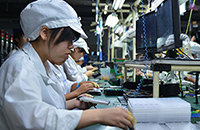
Moving away from exports

There has been talk of a currency war among the major industrialized countries this year. Many people outside China are worried that it will join this tug-of-war to avoid fast appreciation of the yuan, as it still relies on exports to drive economic growth. But this belief is outdated.
In fact, exports as a share of China's GDP began to decline, declining by almost 10 percentage points to 24.5 percent of GDP in 2012 from 34 percent in 2006.
Exports' share of GDP is likely to continue to decrease in the coming years. China's GDP will probably grow by an annual rate of 7.5 to 8 percent in real terms. Adding inflation and the yuan's appreciation, China's nominal GDP will grow by a rate of 12 to 14 percent in terms of the US dollar. In the meantime, factors on both the demand and supply side determine that China's export will not grow by such buoyant rates.
On the demand side, it is unlikely that China's major export markets will recover any time soon. The European Union is still in deep trouble, and the Japanese economy offers no sign of even modest growth. The US economy is growing at a comfortable rate, but its unemployment rate is still high. Most of China's exports to the United States are low-end consumer goods and the high unemployment has reduced the demand for such goods. China's exports to developing countries are increasing rapidly, but the low purchasing power in these countries will not support a high growth in exports.
On the supply side, China is quickly approaching a turning point in its manufacturing, the sector responsible for most of the country's exports. In the course of economic growth, all countries experience notable structural changes. Two of them are linear changes: agriculture's share of employment declines steadily, while that of the service sector increases steadily. The most interesting structural change, however, happens to manufacturing's share of employment. The historical experiences of industrialized countries show that this experiences a hump-shaped trajectory, that is to say it first increases and then begins to decline after per-capita GDP passes a certain threshold. In Japan and the Republic of Korea, this threshold was around $12,000 (in terms of 2005 purchasing power parity). China will probably reach that level of income between 2018 and 2020.
In the interim, it is natural for the growth in China's manufacturing and exports to slow. No wonder most analysts believe that China's exports will maintain a moderate growth of around 10 percent in the coming years. This means that by 2020, China's exports will be less than 20 percent of GDP.
Ten percent is not a bad rate for China's exports. In 2012, China's exports grew by only 7.5 percent. In normal times, the world's total trade volume grows by about 7 percent each year. Therefore, China's share of world trade will still grow.
The role of exports as a driver of China's growth is also diminishing. Between 2001 and 2008, exports contributed at least 30 percent of China's annual growth each year. Now that exports are growing at a rate less than one-third of that, their contribution to overall growth has also dropped substantially, possibly to between 10 and 13 percent.
China is going to have to rely more on services and thus domestic demand to drive growth. The government's decision to accelerate urbanization will speed up this transformation. The key element of this policy is to get rid of the restrictions imposed by the hukou or household registration system. Migrants can expect to be able to settle down in the cities where they work, so their consumption can be expected to increase. In addition, the added urban population will stimulate the growth of the service sector. By 2020, China will become one of the major markets in the world although it will probably still produce a lot for the rest of the world.
The author is director of the China Center for Economic Research and dean of the National School of Development, Peking University.
(China Daily 02/27/2013 page9)