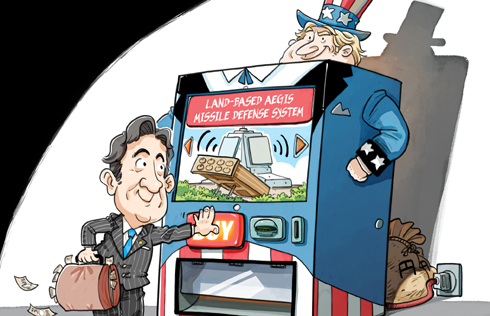
Ending a dangerous game
US should change its approach to territorial disputes in East Asia and make its conduct match its statements of neutrality
Washington must exercise great care or the United States could become entangled in an assortment of volatile territorial disputes in East Asia.
Recently, the most prominent and potentially dangerous dispute has been between China and Japan over the Diaoyu Islands in the East China Sea. But disagreements continue to simmer between China and Vietnam and the Philippines, regarding parts of the South China Sea.
The Barack Obama administration insists that the US is neutral regarding all of these disputes, but US actions, especially over the past three years, belie such professions of neutrality. Washington has increasingly become involved, and in every case, US policy has tilted toward any claimant other than China.
That is an unwise course, since it encourages some nations, especially US treaty allies such as Japan and the Philippines, to adopt uncompromising stances and reduces the prospects for compromise solutions. A policy so biased against China also has the potential to poison the US' crucial economic, diplomatic, and strategic relationship with a re-emerging great power in the international system.
Washington needs to change its approach quickly and make US conduct match its statements of neutrality.
Washington's interest in the South China Sea disputes has grown dramatically in recent years. In a July 2010 speech before a meeting of the Association of Southeast Asian Nations, then-Secretary of State Hillary Clinton emphasized that Washington had important interests at stake in the South China Sea and proposed a "collective regional solution" that projected a mediation role for the US.
The visit of then-Secretary of Defense Leon Panetta to Vietnam the following June further highlighted Washington's escalating involvement, as well as a noticeable bias against China's claims. Panetta's underlying goal was to gain access to the harbor at Cam Ranh Bay for US warships. Referring to the so-called US strategic pivot to East Asia, Panetta told reporters that the US would "work with our partners like Vietnam to be able to use harbors like this".
With the South China Sea as a visual backdrop, he added "it is very important that we be able to protect key maritime rights for all nations in the South China Sea". It was probably no coincidence that Hanoi's stance hardened dramatically over the following months.