US steel policy may trigger a global trade conflict
 |
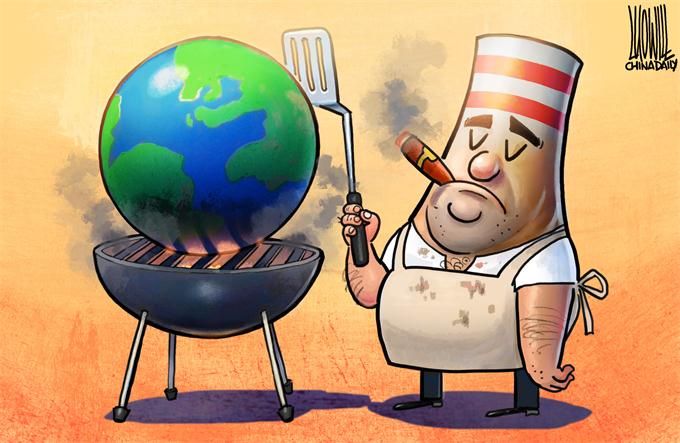
| Shi Yu/China Daily |
As the White House seeks to turn steel imports into a national security matter, the issue is alienating not only China but also the United States' NATO allies. "They're dumping steel and destroying our steel industry, they've been doing it for decades, and I'm stopping it. It'll stop," US President Donald Trump declared during a recent flight from the US to France. "There are two ways: quotas and tariffs. Maybe I'll do both," he added just days before his administration's first Sino-US Diplomatic and Security Dialogue.
Only days after China's ambassador to the US Cui Tiankai warned Washington on "troubling developments" that could derail the bilateral relationship, US Commerce Secretary Wilbur Ross said he would present Trump a range of options to restrict steel imports on national security grounds - even as Europe's NATO leaders were already lobbying against the White House's possible move.
After the meeting between President Xi Jinping and Trump in early April, China and the US announced a 100-Day Action Plan to improve strained trade ties and boost cooperation between the two countries. "This may be ambitious, but it's a big sea change in the pace of discussions," Ross said at the time.
Barely two weeks later, Trump issued a presidential memorandum directing Ross to investigate the effects of steel imports on national security on the basis of the Trade Expansion Act of 1962. If Ross determines steel "is being imported into the US in such quantities or under such circumstances as to threaten to impair national security", Trump is authorized to take action "to adjust the imports of the article and its derivatives so that such imports will not threaten to impair national security".
It was such actions that Trump alluded to in his recent statement, including imposing import quotas, license fees on imported goods and negotiating more restrictive trade agreements.
Since 2000, the global steel market has changed dramatically. Some two decades ago, world crude steel production was still about 850 million metric tons a year. While North America, Europe and Japan (read the G7) accounted for more than half of the total, China's share was only 15 percent.
In the past, advanced economies were the key producers. Today, emerging economies spearheaded by China account for 70 percent of global steel production.
That's the real reason for increasing steel protectionism in the US and the European Union in the past few years. But Trump's latest effort is splitting even the transatlantic front.
With steel imports suddenly becoming an issue of "national security", US Defense Secretary James Mattis has been dragged into the debacle. By mid-June, Europe's NATO leaders joined in as well. They launched an extraordinary lobbying campaign against an anticipated US crackdown on steel imports, which, they argued, would hit US allies more than China. Consequently, Mattis - not Ross - has been hearing the cases of apprehensive German and Dutch NATO leaders and has passed on their concerns to the White House.
During George W. Bush's presidency, the transatlantic axis almost fell apart because of a deep divide in security policy. Now, the same axis is being strained to the hilt by deep divisions in economic, trade, climate and steel (read security) policies.
Washington's NATO allies do not buy the national security argument. In Brussels, the mood is growing for retaliation if the Trump administration were to walk the talk.
Ross seemed to be pushing for a trade war over steel in a closed-door meeting with Senate Finance Committee members, but he has not put a time frame on his review's release. Officially, he has 270 days to submit a report to Trump - which translates to anytime between soon and late fall.
What next?
If Ross finds that steel imports threaten to impair national security, Trump must determine within three months whether he concurs with the commerce secretary's findings, and what actions should be taken.
In practice, the White House's current goal is to ramp up "America First" pressure on the eve of Trump's first Sino-US dialogue. Theoretically, Ross and Trump can defer difficult decisions on steel only until early spring 2018.
However, a Pandora's box has now been opened and an adverse decision could not just derail Sino-US bilateral relations, but alienate Washington's NATO partners and undermine much of past economic progress worldwide.
The author is the founder of Difference Group and has served as research director at the India, China and America Institute (USA) and visiting fellow at the Shanghai Institutes for International Studies (China) and the EU Centre (Singapore).