In search of beauty
 |
|
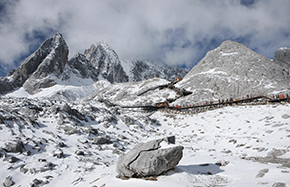
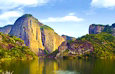
Under the brilliant blue sky, Hailuogou is a peaceful refuge where the vista includes snow-sculpted mountains, a rare low-altitude glacier, silent Tibetan prayer stone altars, beautiful trees and rare animals. Photos by Xu Xiaomin / China Daily |

In the vastness that is China, there are still hidden spots of great natural splendor ?although you must be prepared to work hard searching. Xu Xiaomin puts on her hiking boots.
The truly scenic places, those that draw the involuntary intakes of breath at their sheer beauty, are never for the lazy. These hidden attractions are meant for those who are willing to endure a long trip and hours of walking in search of the scenic gems. Hailuogou in Sichuan province is one of these jewels. This is one of Sichuan's lesser-known attractions, about 300 kilometers southwest of Chengdu, the capital. If you are nimble on your feet, and enjoy a good energetic hike up the mountains, your reward will be a peaceful piece of paradise undisturbed by cacophonous crowds.
Hailuogou, or trumpet shell valley, offers a panoramic vista that includes the snow-covered 7,556-meter-high peak of Mount Konka, often called the king of mountains in Sichuan. You can also see a rare low-altitude glacier, silent Tibetan prayer stone altars, beautiful trees and lovely animals - all encompassed in crystal clear pure air.
But you have to start the journey with a seven-hour drive from Chengdu.
The trip to Hailuogou is anything but boring. After driving on the Chengdu-Ya'an highway for about two hours, we then started along the 318 National highway, often called the most beautiful tourist route in China.
Along the way, the driver stopped for 10 minutes at the entrance of the Erlangshan tunnel. Stretching more than 4,000 meters in length, the tunnel is the longest in China, and it is also the highest in terms of altitude.
Some travel magazines had described this tunnel as a photographers' dream and I could not understand why until we actually passed through. At the other end, the weather and mountains suddenly looked totally different. The terrain had become a lot higher, and the sun shone brighter, chasing away any visages of sleep that still lingered.
The second stop was at Luding Bridge, which has 13 iron chains connecting both banks of the Dadu River. This is also a famous landmark in the history of the Communist Party of China (CPC). In 1935, while fending off attacks from the Kuomintang army, the Red Army crossed the bridge after a two-hour battle.
Decades later, the once bloody battlefield is now filled with happy visitors who put on military uniforms of both Kuomintang and CPC and pose for pictures by the bridge. Residents, immune to the fuss, play mahjong under the battery of red flags and property billboards hung on towers.
As we gingerly crossed the shaky bridge, I looked down through the gaps between the wooden planks and watched the rushing water beneath. I was overcome by a dizzy feeling mingled with fear as I imagined the cruelty of a battle that took place more than 70 years ago.
In another hour, we had arrived in Moxi town, where Hailuogou is located.
You can kill time here by dropping into a temple called the Golden Flower, where Chairman Mao Zedong once visited, or spend 150 yuan to attend a party where Tibetan actors invite you to dance with them. For me, the barbecue stands on the street were more attractive. For just 30 yuan per person, you could eat like a king.
The second day was when we entered Hailuogou. It was beyond amazing, and the exclamations of delight and disbelief became our mantras for the day.
It was a sunny day, rare according to the locals, and we took full advantage of every minute. After another half hour navigating some perilous curves up the mountain, we turned a corner - and a really huge snow-covered mountain loomed before us.
It was almost unreal, its peaks sparkling under the rays of sunshine like precious metal.
As the driver sped around one curve after another, we were almost too oblivious to be scared. All we saw and cared about were the snowy peaks before us. Sometimes they appeared so close that I felt I could reach out and touch them if I jumped off the bus. Who had time to worry if the driver was hell-bent on falling off the cliff?
Finally, the coach stopped at camp No 3, 2,980 meters up the mountain. From here, we took a cable car to camp No 4, another 500 meters above sea level. This was where we could get an uninterrupted view of Konka and the No 1 glacier.
The No 1 glacier, called the "big ice waterfall" in Chinese, is 1,100 meters across and more than 1,000 meters thick. Looking down at the glacier from the cable car, it does resemble a frozen waterfall caught in mid-gush as it flowed from the mountain.
Some visitors walk down a passage from the camp to touch the glacier, but I think its beauty is still best appreciated from a distance.
The view from the camp was the most memorable during our 11-day trip to Sichuan, perhaps even the most unforgettable from all my travels around China.
Like the children coming out from the wardrobe in The Chronicles of Narnia, my feelings were one of total amazement as we entered this beautiful icy world.
In front of me was the great panorama: silent snowy mountains with a wisp of tender white cloud girding its middle so that it appeared to be floating on air; unnamed trees and plants tried their best to stretch snow-topped branches disfigured by cold and wind. Small red berries in the bushes shone like rubies in the shrub.
Through a small passage behind the viewing platform, I walked upward to about 3,500 meters. On the way, I met several workers building a Tibetan-style alter. They moved slowly, and looked to be casually strolling about instead of working. I didn't see any signs of fatigue on their faces, unlike the worn-out migrant workers' faces in Shanghai.
Thousands of jingfan, colorful pennants printed with Buddhist scriptures and Tibetan motifs, hung around the half-completed altars.
These strong colors broke the monotony of white on the mountain and shone against the sapphire of the sky. It was a stark yet harmonious contrast.
The path faded and more rocks appeared and I continued to climb, trying to get closer to the mountain.
Soon the rocks around me took on the color of the hongshitan, or red stone land. There was a solitary tree growing from the rocks, just like a lonely spirit dancing alone. Under the tree were dozens of manidui, small piles of stones which the Tibetan people use for prayer. These piles were probably made by tourists like me, and I added my own, together with a prayer that I will find it still intact the next time I came back.
Back at Camp No 3, there is a trail where hikers can wander through a forest which is a haven for small plants and animals. Leaves and lianas of every shape and color made it seem almost equatorial and squirrels jumped from tree to tree while underfoot, a carpet of alpine flowers bloomed.
It was enough to make us forget the time and indeed, we had to rush to catch the last bus back to town.
Our heads were still full of the awesome beauty we had just seen and as we raved about the beauty we had just left, a local peddler who sold us soft drinks merely shrugged it off: "That is nothing."
Despite my conviction that I had just seen a piece of natural paradise, I understood this folksy philosopher's point of view. He lives here and he's probably immune to it all. How fortunate I am to be just a traveler passing through who can do no less than to appreciate and treasure this beautiful experience.