The Zhuang ethnic group
The Zhuang ethnic minority is China's largest minority group. Its population of 16,178,811 approaches that of Australia. Most of the Zhuang people live in southwest China's Guangxi Zhuang autonomous region, which is nearly the size of New Zealand. The rest have settled in Yunnan, Guangdong, Guizhou and Hunan provinces.
While most Zhuang communities concentrate in a compact area in Guangxi, the others are scattered over places shared by other ethnic groups such as Han, Yao, Miao, Dong, Mulao, Maonan and Shui.
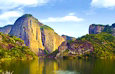
Lying in Guangxi's mountainous regions, the Zhuang area is high in the northwest, undulating in the middle and low in the southeast. Limestone is widely distributed in the area, which is known around the world for its karst topography. Many rocky peaks rise straight up from the ground, and the peaks hide numerous fascinating grottoes and subterranean rivers. Guilin, a tourist attraction in Guangxi, is an excellent example of such landscape. As the saying goes: "The landscape at Guilin is the best on earth; and the landscape at Yangshuo is the best in Guilin." Wuming, Jingxi and Lingyun counties are also known for their scenic splendours.

Crisscrossing rivers endow the Zhuang area with plentiful sources of water for irrigation, navigation and hydropower. The coastline in south Guangxi not only has important ports but also yields many valuable marine products including the best pearls in China.
The Zhuang area enjoys a mild climate with an average annual temperature of 20 degrees centigrade, being warm in winter and sweltering in summer in the south. Plants are always green, blossoming in all seasons. Abundant rainfall nurtures tropical and subtropical crops such as rice, yam, corn, sugar cane, banana, longan, litchi, pineapple, shaddock and mango. The mountains in southwest and northwest Guangxi abound in Liuzhou fir, silver fir and camphor trees, rare elsewhere. Mineral resources include iron, coal, wolfram, gold, copper, tin, manganese, aluminum, stibium, zinc and petroleum. The area is also rich in tung oil, tea, tea oil, mushroom, Chinese cinnamon, pseudo-ginseng, Chinese gecko (used in traditional Chinese medicine to help regain vitality), fennal and fennal essence. The last four items are the Zhuang area's special products.
History
"Zhuang" was one of the names the ancestors of the ethnic group gave themselves. The term was first recorded some 1,000 years ago, in the Song Dynasty. The Zhuang people used to call themselves by at least a dozen other names, too.
The Zhuang areas first came under the administration of China's central authority 2,000 years ago. In 221 B.C., the First Emperor of Qin, China's first feudal emperor to unify the country, conquered the area and established three prefectures there. The emperor had the Lingqu Canal built to facilitate irrigation. He also started a project to move people from other places to the area, strengthening its political, economic and cultural ties with the central-south part of the country.
In the centuries that followed, a number of powerful clans emerged in this area, who owned vast tracts of land and numerous slaves and servants. Still later, during the Tang and Song dynasties, social and economic development was such that irrigated rice paddies, farm cattle, iron, copper and spinning and weaving spread far and wide.
However, the Zhuang area still lagged behind central China economically. Quite a number of places retained the primitive mode of production, including slash-and-burn cultivation and hunting. The dominant social system was feudal serfdom and people were classified into three strata: hereditary landowners, tenant farmers and house slaves. The system was eliminated during the Qing Dynasty (1644-1911), the last feudal monarchy in China.
Administratively, most of the Zhuang area was governed by the headmen system over 1,000 years from the Tang to Qing dynasties. Backed by the central authorities, the local headmen oppressed and exploited the Zhuangs, forcing them into hundreds of uprisings.