Cleaning up water gets a boost from brand new method


A new technology has appeared to help China - and everyone - with their water pollution problems.
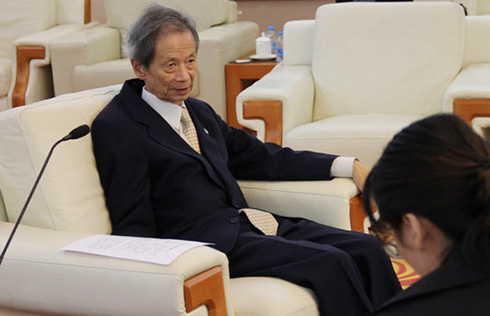
It comes courtesy of Beijing-born MIT post-doc Xiao Su, his mentor Professor T. Alan Hatton and team, who just won the 2016 MIT Water Innovation Prize, as well as last year's Veraqua Prize, an award focused specifically on water purification methods for pollutants in China.
China faces a diverse range of pollution, Su said in an email to China Daily: Industrial, urban wastewater and agricultural, chemical pollutants such as organics and heavy metals are a major problem, with pharmaceuticals, dyes and personal products present in urban sources or pesticides and herbicides in rural areas.

The big challenge right now, Su explained, is the inefficiency of existing technologies to remove really toxic, yet often diluted contaminants (micropollutants), present at low parts-per-million or -billion levels.
Su and Hatton describe their new approach in the current issue of the journal Energy and Environmental Science.
Their system uses a novel electrochemical process to selectively remove organic contaminants such as pesticides, chemical waste and pharmaceuticals, even when they are present in small - yet still dangerous - concentrations.
The current methods of sifting out such trace amounts of toxins include filtering the water through a membrane, which is expensive and not 100 percent effective, or electrodialysis, which requires high voltages that often produce unwanted side reactions, Su said.
As Hatton put it, "In our case, you can just flip a switch."
In their system, the water flows between chemically treated surfaces that act as positive and negative electrodes and undergo reactions to become positively or negatively charged and can be "tuned" to bind with a specific pollutant. The team used ibuprofen and pesticides to demonstrate their model and removed molecules at parts-per-million concentrations.
Su said their system "can have a key impact in addressing these pollution problems in China, as we provide the necessary selectivity to remove these toxic species across a range of concentrations, even very small".
Su claims their technologies can "achieve dramatically higher, over 100 times more selective, performances".
Using electrochemistry makes the system more sustainable and environmentally friendly, as there is no need for chemical additives or tons of solvents to reboot the operation.
The process can be scaled from home to community. "For home filtration, our system is perfect for removing any trace contaminants coming from tap water," Su said.
"We can also be deployed in small communities of 500-1,000 people, and integrate our systems with solar panels. This way, we can reach remote and rural areas and also ameliorate the cost of electricity," he said.
From a practical point of view, Su said they are working prototypes and exploring pathways to commercialization. "Our timeline is for the first prototypes to be developed by the end of this year, latest mid next-year, and the scale-up process to hopefully lead to a competitive product line by the end of 2018," Su said.
In additional to all the good things the technology can do for the environment, it also shows promise for two other uses - upstream water purification to help recover valuable species and selectively "mining" or "recovering high-value compounds in a chemical or pharmaceutical production plant, where they might otherwise be wasted," Su said.
The researchers have applied for a patent on the new process. "We definitely want to implement this in the real world," Hatton said in a press release.
"We expect our system, ,with some further scale-up development, to make a real difference in helping China conquer their challenges, as an energy efficient, high-performance alternative to conventional pressure or thermally based methods," Su said.
Contact the writer at chrisdavis@chinadailyusa.com