Are big storms proof of climate change? Maybe not


Why me? is the question victims of Nature's random fury naturally ask.
With vast stretches of the southern US still reeling from the devastation brought by two monster storms, an editorial in the medical journal The Lancethelps put things in perspective, and raise a few profound questions.
Over the past few weeks, the volume of rain and floods — not just in Houston but across the globe — has been "unprecedented" and "difficult to comprehend", Lancet editors write.
In Asia, more than 1,400 people are dead and tens of millions awash in extreme monsoon rains. A third of Bangladesh is submerged with its worst flooding in 100 years. Half a million people in Nepal have had their food sources threatened by flood waters.
In late August, Typhoon Hato, the strongest storm in the region in 50 years, pummeled the Philippines and Macau and in Sierra Leone, West Africa, 499 people were buried alive in mudslides triggered by torrential rains.
Hurricane Harvey was Houston's third 500-year flood in three years. One study predicts that by the end of the century, climate related deaths will rise from current level of 3,000 to 152,000 annually.
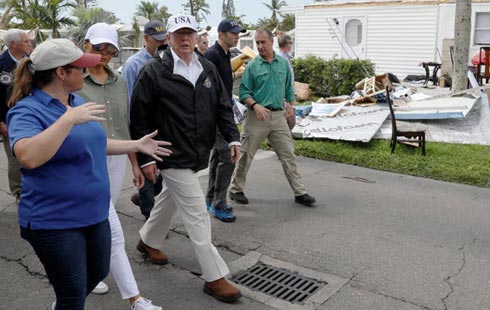
And as southern Florida emerges from the wrath of Hurricane Irma, it comes as little surprise to hear that Miami's mayor says this might be a good time to talk about climate change.
But not so fast. Nancy Selover, a professor at Arizona State University's School of Geographical Sciences and a self-professed big believer in global warming, thinks the trio of Harvey, Irma and Jose are really just a terrible and unfortunate and "rare coincidence."
"I don't think this is a result of global warming as we have had many storms more powerful thanthese prior to 1960, including many Category 5 and 4 storms," she said.
Irma's 185 mph winds dropped to a Category 4 before making landfall. The 1935 Florida Keys "Labor Day" hurricane hit land as a Category 5, as did Andrew when it slammed into Dade County, Florida, in 1992.
The record holders for sustained winds, by the way, are in the Pacific — 1961's Typhoon Nancy and 2015's Hurricane Patricia — both clocked in at 215 mph. Irma could have set the record for the Atlantic, once all the data are analyzed.
The tendency, Selover explained, is to focus on more recent storms as being worse than historical ones because we have such better coverage of them and, unfortunately in many cases, more people in their paths. The chances of a hurricane hitting the southeastern United States are the same now as they were 100 years ago, she said.
Climatologist Randy Cerveny, who works with the United Nations-related World Meteorological Organization, said the trifecta of Harvey, Irma and Jose is not that unusual.
"This is the normal time (early-mid September) that we have the peak of the Atlantic hurricane season," he said. He also mentioned that the trio is a demonstration of their improved long-range prediction methods, which had forecast that this would be an above-average season.
Cerveny said that some theoretical research suggests that with global warming, hurricanes my increase in size and intensity, "but there is still much debate about that in the scientific community." And in general hotter climates produce more evaporation and thus more rainfall, but Harvey's inundation of Houston was primarily because a giant high ridge of pressure in the southwest stalled the storm over the Gulf Coast.
He said it was difficult to attribute one storm's impact to climate change. It's just as "absurd" to say that one hurricane in summer confirms global warming theory, as it is to say that one snowstorm in winter contradicts man-made global warming.
"Climate is 'long-term' while meteorology is 'short-term,'" he said.
Selover had a great answer when a reporter asked her what preventative measures we as a society can do to ensure the longevity of our planet.
She said it was "an impossible question to answer as the planet will be fine regardless of what we do.
"The longevity of ourselves and the ecosystems are of more concern. The Earth has changed drastically over hundreds of millions of years and will continue to do so, with or without us."
Contact the writer at chrisdavis@chinadailyusa.com.