



Harbin tech students send tiny satellite into orbit









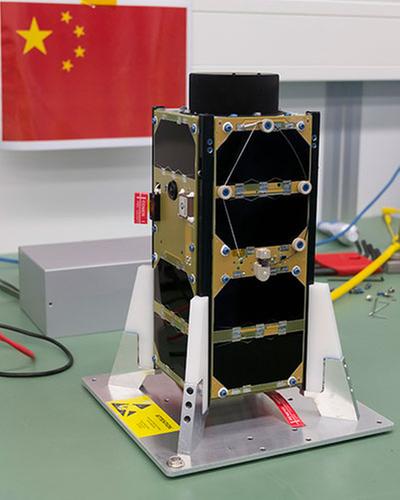 |
| LilacSat-1, a satellite developed by students at the Harbin Institute of Technology. |
A nanosatellite made by students at the Harbin Institute of Technology was launched in the United States on Tuesday as part of a mission to the International Space Station.
The satellite, LilacSat-1, was on a Cygnus cargo spacecraft launched atop an Atlas 5 rocket from Cape Canaveral in Florida at 11:11 am, according to Wei Mingchuan, the 26-year-old team leader and a second-year PhD candidate in astronautics at the institute in Heilongjiang province.
LilacSat-1 consists of two conjoined cube units, each with a side length of 10 centimeters. The 2-kilogram satellite will be deployed at a height of about 400 kilometers above the ground from the space station within three months of docking with the cargo craft. Docking is scheduled for Saturday.
In its three-month life span in orbit, the satellite will conduct investigations on Earth's mid-lower thermosphere, a section of the upper atmosphere about 200 to 400 kilometers above the ground.
"We will take measurements of the upper layers of the atmosphere using an ion-neutral mass spectrometer," Wei said. "In addition, we have a new type of radio repeater to provide two-way communication resources to amateur radio operators, as well as a CMOS camera to take photos from space."
Nanosatellites are small satellites that weigh between 1 and 10 kg, according to the team.
Lifted along with LilacSat-1 were 27 other nanosatellites of the QB50 project, a European Union-funded miniaturized satellite constellation created by students in more than 20 countries.
"This project is the very first international, real-time, coordinated study of thermosphere phenomena," said Davide Masutti, QB50 project manager at the Von Karman Institute, a scientific organization based in Belgium.
Wei said the data retrieved by LilacSat-1 would be shared by the science community and amateurs, as the programs will be released as open-source and require no special tools.


- Senior enterprise official facing probe
- China's anti-graft authorities reveal extent of year's work
- Former Haikou Party chief gets death sentence with reprieve
- Purchase of US-made weapons to push Taiwan closer to the peril of war: spokesman
- WIC calls for submission of cultural heritage digitalization cases
- China calls for global opposition to Japanese neo-militarism










