



Weigh pros and cons before randomly using AI technology









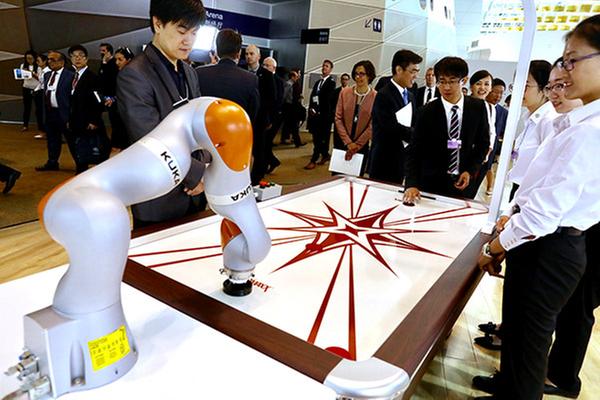 |
A man playing with a robot during the World Economic Forum, June 27. [Photo by Zhu Xingxin/China Daily] |
Artificial intelligence was a catchword at the Summer Davos forum in Dalian, Liaoning province, which concluded on Thursday. While participants from the academia, governments and the corporate sector had in-depth discussions on the future of AI technology at the three-day event, consultancy companies released reports highlighting the economic benefits of AI for China and the world at large.
Global GDP in 2030 will be 14 percent higher-an addition of $15.7 trillion-as a result of AI thanks to improving labor productivity and increasing consumer demand owing to the fast-paced application of AI technology, says a report by consultancy company PricewaterhouseCoopers, which was released on Tuesday on the sidelines of the Summer Davos forum or, officially, the Annual Meeting of the New Champions 2017.
And an Accenture report says AI could help China's economic growth accelerate to 7.9 percent from 6.3 percent by 2035, by "transforming the nature of work and opening new sources of value and growth".
The two reports could boost the morale of economic policymakers and the public, and testify to the power of technology in transforming not only people's daily lives, but also economic activities as a whole.
However, history tells us that, while technological advancements have brought us benefits, they have also led to great social upheavals, by, for example, changing the production and labor structures, and forcing many workers to either adapt to the changes or lose their jobs. In the 18th century, for instance, skilled workers rose up in revolt to resist the Industrial Revolution, with their protests culminating in the Luddite Movement that saw textile workers and weavers destroying machinery in the early 19th century.
We may not see similar protests today, but history should serve as a warning against the indiscriminate development and application of AI technology. While we may gain a lot of benefits from AI, we must work out plans to offset its negative impact on society, especially for workers.
AI can raise productivity and expand GDP, but it can also render non-adaptive workers jobless. In India, some technology personnel have already felt the negative impact of information technology. As technology industries across the world seek increasing support from automation, robotics and big data analysis, some Indian technology workers employed in service outsourcing sector have already lost their jobs.
In their 2013 research study, Michael Osborne from Oxford University's Department of Engineering Science and Carl Frey from Oxford Martin School estimated 47 percent of the jobs in the United States are "at risk" of being automated in the next 20 years. They said jobs in transportation and logistics sectors, and office and administrative support are at high risk of being automated.
And Kaifu Lee, founder of venture capital company Sinovation Ventures, who served as senior executive at tech giants such as Google, Microsoft and Apple, recently said that robots could take away about 50 percent of all jobs from humans in the next decade.
Those estimates may sound sensational and the impact of technological advancement may not be that serious, as it will also generate jobs in emerging industries, but still policymakers should deliberate how to better embrace the technological wave to bring benefits to both the economy and the people while taking pre-emptive action to minimize its negative impacts.
The government therefore needs to engage with the corporate sector and social organizations and allocate more resources to promote and improve training programs for potentially vulnerable workers and professionals, in order to make them more capable of adapting to the structural changes in industries and job markets in the future.
Regrettably, business leaders spent a lot of time talking about the potential contribution of AI to economies at the Summer Davos forum, but failed to give equal weight to the challenge of minimizing its potential impact on society, especially the job markets. Scholars and policymakers need to fill that void.
The author is a senior writer with China Daily. xinzhiming@chinadaily.com.cn





