



Everyone should join the AI debate









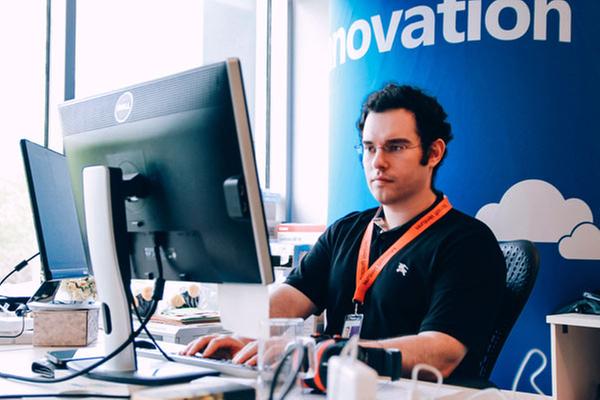 |
| Matt Scott sits in his office in Shenzhen, working on his AI research and development business. [Photo provided to China Daily] |
The Chinese government recently announced plans for a massive investment and research program aimed at turning the country into the world leader in artificial intelligence by 2030. Artificial intelligence represents the latest goal in a technological revolution that in recent decades has changed not only the world but also the way we live, work and communicate.
It is a field in which China aims to catch up with competitors such as the United States by 2020 and overtake them in the subsequent decade to make AI a driver of its economic transformation.
The promises of AI sound impressive, but what exactly is it?
Most ordinary people can get their heads around the concept of the self-drive car and appreciate its potential advantages. For many, however, the prospect of machines one day being more intelligent than humans conjures up science fiction forebodings of a nightmarish world in which the same machines actually take over.
Even tech experts are divided over the direction that AI development should take if we are to avoid the potential pitfalls.
Elon Musk, CEO of the car and rocket giants Tesla and SpaceX, recently said, only half-jokingly, that the reason humans should colonize Mars was to provide a refuge from the thinking robots destined to take over the world. The billionaire AI-skeptic is worried that humans could accidentally stumble onto technologies that could lead to their own destruction. As early as 2014, he described AI as humankind's biggest existential threat.
Similar warnings have been sounded by Stephen Hawking.
Some tech innovators are more relaxed. Ray Kurzweil, a leading tech developer, is confident that sensible controls can head off the prospect of nightmare scenarios. He has cited advances in biotechnology, which was once regarded as a potential threat by those alarmed by the prospect of scientists tampering with human DNA.
Kurzweil has written that biotech guidelines established over several decades had worked very well. "There have been no significant problems, accidental or intentional, for the past 39 years," he wrote in a 2014 blog. "We are now seeing major advances in medical treatments reaching clinical practice and thus far none of the anticipated problems."
The arguments of Kurzweil and others that humans have faced existential challenges in the past and somehow overcome them are comforting. Most innovations since the dawn of time have had a potential for good and evil. The caveman's spear could be used to catch dinner or annihilate his neighbor.
The four great inventions of ancient China were the compass, paper, printing and gunpowder. It's another matter that we might be better off if the last one had been reserved for making fireworks rather than being developed by others for the industrialization of war.
But, as most of us would concede, you can't stop progress. AI will sooner or later become a reality, and one positive sign is that scientists worldwide are collaborating to ensure it is not misused.
Massachusetts Institute of Technology began collaborating with Tsinghua University and other Chinese institutions over the past decade on AI and other high-tech fields. In a 2010 report, MIT said: "If we are going to be involved in the resolution of global problems-whether sustainable cities, climate change, resource depletion, disease control or any other-we have to be able to understand and engage partners in China."
With China set to take the lead in AI research, it and its international partners will also be looking at the potential disruptive consequences of the new technology in terms of job replacement and global security.
As Fei-Fei Li, AI expert and chief scientist of Google Cloud, recently told Xinhua News Agency, AI could be used to benefit humanity or cause it big problems. Everyone should be involved in the debate, she said. "Silicon Valley leaders, professors, students, policymakers, lawmakers, educators ... everybody should be at the table discussing this."
The author is a senior editorial consultant for China Daily. harveymorris@gmail.com





