



New US sanctions against Russia may harm transatlantic relations









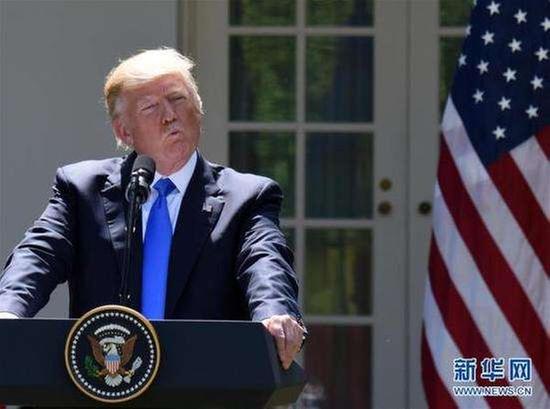 |
| US President Donald Trump [Xinhua] |
In recent days, Vice President Mike Pence has been visiting Estonia, Georgia and Montenegro in an effort to reassure America's partners that it remains committed to collective defense against Russia.
President Donald Trump himself has softened his rhetoric on Europe, although he does not believe in the importance of European integration. Hence, some security concerns have naturally been eased in recent weeks.
However, other problems in transatlantic relations have been apparent since January and cannot be necessarily alleviated with some goodwill visits or a generally calmer tone in Washington in comparison with the pre-election period.
US economic policy vis-à-vis Russia could also have a serious impact on the relationship between Washington and Brussels. This issue is currently on the agenda after Trump signed legislation levying new sanctions on Moscow and restricting his own ability to ease them.
Specifically, sanctions will be extended to third-country companies that cooperate with Russia on large infrastructure projects, notably in the energy sector. As a result, some European companies doing relevant business with Russian counterparts will be seriously affected.
The only concession gained by the Europeans is a 30-day consultation period, but this does not seem sufficient to ease fears of a major disruption in trade patterns.
Attention has turned towards Germany, where a lively debate on the potential construction of Nord Stream II is evolving. If constructed, this pipeline will transport Russian gas to Germany under the Baltic Sea, complementing Nord Stream I, which was completed six years ago.
The project is controversial because it is not in line with EU strategy to reduce energy dependence on Moscow. While it is not clear how Berlin will act over Nord Stream II, those supporting the pipeline focus on its economic importance while ignoring any political repercussions.
In this context, German Minister for Economic Affairs and Energy Brigitte Zypries, in a recent interview, criticized recent sanctions as "against international law, plain and simple" and called on the European Commission to look into countermeasures.
Her interview is similar in content to comments by Foreign Minister Sigmar Gabriel, who has said Berlin will not tolerate sanctions against European companies involved in the Nord Stream project.
The head of the German Chamber of Industry and Commerce, Volker Triere, went even further and directly criticized the US for "looking to its own economic interests." In particular, Germany and some other European countries are suspicious that the US is pushing new actions against Russia in order to serve its own energy interests and promote liquefied gas exports to Europe. If this is the case, Trump is practically implementing his "America First" policy.
Nonetheless, although the US president is perhaps attempting to help American energy companies increase their profits, the new sanctions might cause a serious economic misunderstanding with Europe.
It is too early to describe it as a trade war, but that could happen if misunderstandings escalate. Should Trump impose tariffs on steel imports, for example, the red line will be crossed. Then, the EU will proceed with retaliatory tariffs.
All in all, after the new American sanctions against Russia were approved with a large bipartisan majority in Congress, Germany is left in the middle of American-Russian hostility.
Last May, German Chancellor Angela Merkel met with Russian President Vladimir Putin in Sochi. Despite the prolongation of European sanctions against Russia a few weeks earlier, Merkel is certainly interested in exploring the opportunities of the so-called selective engagement approach towards Russia.
Although such a foreign policy shift will take time, Trump will possibly accelerate the process. In that regard, The Guardian, a leading British newspaper, portrays the situation as an awkward moment in which Europe – principally Germany – is "somehow siding with Putin against the US Congress."
Future developments can hardly be anticipated. Transatlantic relations have certainly entered a new period of crisis, which might increase tensions between Washington and Brussels in spite of Trump's NATO security commitment.
At the same time, the Russian reaction to sanctions – ordering the US to cut its diplomatic mission by 755 people – dashes any hopes for a rapprochement between the two countries. This is a lose-lose political development. Experience suggests that world challenges can only be dealt through enhanced international cooperation.





