



IMF misreads the dynamics of debt









 |
| LI MIN/CHINA DAILY |
Given its reputation and influence, it's unprofessional of the IMF to take such a long time to correct its erroneous low forecast of China's economic growth, especially because the country's economy has grown by 6.7 percent to 6.9 percent for eight quarters.
It's difficult to accurately forecast GDP growth considering the multiple and complicated variables that influence each other, but the IMF's earlier forecasts suggest it was unnecessarily pessimistic about the Chinese economy.
A high debt level, a variable the IMF has emphasized, can influence China's economic performance, but it remains a disputable index which China's financial regulators and economic sector have also paid great attention to.
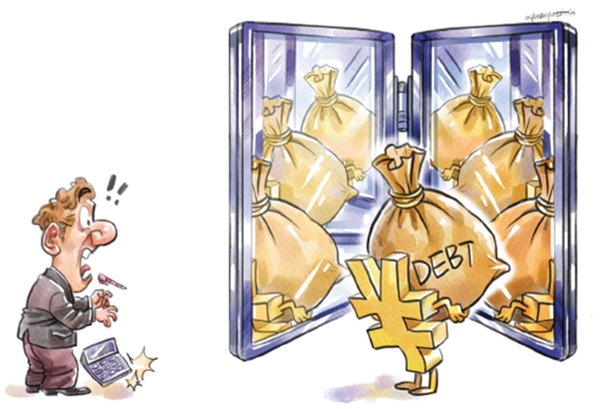
It is necessary to emphasize the significance of this index and devise ways to prevent the risks it might bring. But the IMF's assertion that China's non-financial sector's debt will exceed 290 percent of GDP in 2022 and that it has already reached a dangerous level are exaggerations, which could mislead public opinion. Despite the hullabaloo over a possible "hard landing" of the Chinese economy in the past two decades, it continues to be strong.
It is somewhat true that China's debt level is high, but we should analyze the index using the global prism. When an economy grows at an exceedingly fast pace or has reached a certain development stage, its debt level will be high. Even the developed economies of today, including Great Britain and the United States (and later Japan and the Republic of Korea), have all had high debt levels at some stage of their economic development. And only if we see China's debt from this perspective can we analyze the level of China's debt.
Besides, China's is a special case, as its economy is still centered on indirect finance. In 2014, former chairman of China Banking Regulatory Commission Shang Fulin said the ratio of indirect finance in China is as high as 80 percent, while that in other G20 countries is between 25 percent and 35 percent, while in the US it is less than 20 percent.
A high indirect finance ratio results in many repetitively calculated debts- a typical example being the huge amount of circulatory loans. It is difficult to clearly calculate what percentage of this contributes to China's 236 percent debt in 2016.
The Chinese government, unlike what the IMF said, is not reluctant to control the soaring debt level in order to expand its economy to a certain level by 2020. Instead, it pays great attention to debt control.
Over the past two years, the government has been carrying out supply-side structural reform, and one of its top priorities is deleveraging, because it can help manage M2 (a measure of money supply) as well as the business sector's debt ratio.
The debt ratio of China's public sector is less than 50 percent, which is a safe level. Moreover, the administrative authorities have never tried to hide the problem of rising debt among enterprises. Taking the efforts to prevent financial risks to a new level, the recent National Central Finance Conference announced the establishment of a Financial Stability and Development Committee under the State Council, China's Cabinet, with the aim of boosting the real economy, deepening financial reform and tightening financial supervision and risk prevention, including keeping the overall debt level in control.
President Xi Jinping and Premier Li Keqiang, too, have emphasized State-owned enterprises' deleveraging and strictly controlling local government debt.
The government's prudent attitude toward the debt level is in line with the IMF's economic philosophy, but the IMF's views on the government's attitude toward debt is biased and too pessimistic.
Hence, we should regard the IMF's remarks as a prewarning, but we don't have to be too worried about it.
The author is the director of the China Academy of New Supply-side Economics.





