



Elderly key players in global development agenda









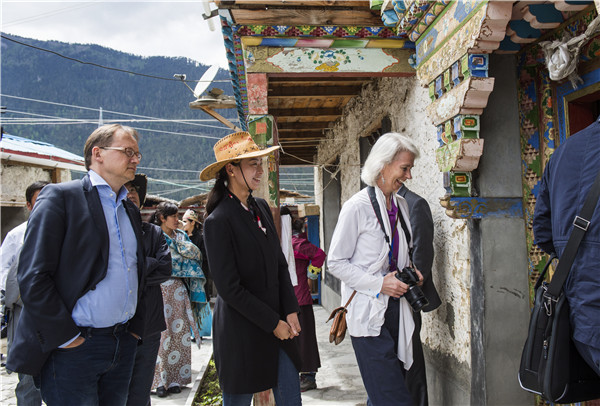 |
| Representatives of the United Nations visit a family hotel in Lulang town of Nyingchi city, Southwest China's Tibet autonomous region, May 29, 2016. [Photo/Xinhua] |
As the number of elderly in the Asia-Pacific region increases exponentially, we must seek new and innovative approaches to turn this demographic trend into an opportunity to help achieve the ambitious targets of the 2030 Agenda for Sustainable Development.
The number of elderly people in the region is expected to more than double, from 535 million in 2015 to about 1.3 billion by 2050, we need to consider what effects this will have on the region's economies and societies, as well as people's livelihoods. Ignoring this challenge would likely have profound consequences. We cannot leave the care of the aged to their families nor can we ignore the need for progressive healthcare and income support systems. Future economic growth cannot be assured by the current and projected working-age population. The ratio of the working age population to the elderly population is decreasing sharply, and in most countries of the Asia-Pacific region, less than one-third of the working-age population contributes to a pension.
Traditional systems rely on the family to support their aging relatives-both financially as well as providing care for those who need it. However, with smaller families, there will be fewer family members of working age to shoulder this responsibility. Declining family support ratios also have implications for existing social security provision, particularly pay-as-you-go pension schemes, under which the contributions paid by current workers support the pensions of retirees.
When one considers the differences in the average age at marriage, coupled with the longer life expectancy of women, women outlive their spouses on average by a range of 4 to 10 years. Yet, as the proportion of women in the population increases with age, women are less likely than men to have adequate pension benefits or control over assets, such as land, in their old age. Special social protection measures are therefore required to redress the feminization of poverty, in particular among older women.
There is a linear relationship-although not a causality-between GDP per capita and the level of population aging, which shows that countries with higher incomes tend to be more advanced in the aging process. Some countries became old before becoming rich, such as Georgia, Armenia and Sri Lanka with per capita incomes between $3,500 and $4,100 and a proportion of older persons between 13 and almost 20 percent.
To economically benefit from our aging populations, we must ensure that the elderly who want to work have the right to and are provided with opportunities for re-employment. The statutory retirement age across Asia and the Pacific is low, considering the current and increasing life expectancies, resulting in long retirement duration. Eliminating age barriers in the formal labor market would help to ease the fiscal pressure on pension and healthcare systems. Allowing older people to work as long as they are able and willing would sustain their self-sufficiency and reduce their social alienation. We can turn the phenomenon of population aging into a second demographic dividend, with financially secure, healthy elderly people, who are empowered to focus their decades of accumulated experience, wisdom and wealth to stimulate new economic growth.
With the right preparation, we can benefit from a golden generation of healthy, wealthy and active senior citizens. In 2002, the United Nations brought countries together in Madrid to agree on a global way forward: to treat older people as actors in development; to ensure their health and well-being; and to create enabling and supportive environments for them. A few weeks ago, representatives from 29 governments in our region assembled in Bangkok to add new resolve to their existing commitments during the Asia-Pacific Intergovernmental Meeting on the Third Review and Appraisal of the Madrid International Plan of Action on Ageing.
The Economic and Social Commission of Asia and the Pacific is working to support countries to turn their commitments into action, to secure increasingly inclusive and sustainable economies and societies for all ages across the region.
We grow wiser, together.
The author is under-secretary-general of the United Nations and executive secretary of the Economic and Social Commission for Asia and the Pacific.
- China's Position Paper on the Implementation of the 2030 Agenda for Sustainable Development
- UN Secretary-General: China demonstrates great leadership to advance 2030 Agenda
- China's efforts for 2030 Agenda for Sustainable Development
- China to continue efforts to implement UN 2030 Agenda: President Xi





