



Like it or not, driverless vehicles loom









Consumer reluctance may pose a roadblock, but such cars represent the future and we will be seeing a lot more of them
The era of the driverless car, we are told, is almost upon us. From Silicon Valley to Stuttgart to Shanghai, developers are moving into top gear in a race for a global market predicted to be worth $7 trillion by 2050.
In Britain, Chancellor of the Exchequer Philip Hammond said this week that the country's carmakers would have fully driverless vehicles in use by 2021. And Elon Musk, the US tech sector guru and boss of Tesla, said he believes that most vehicles on the road will be autonomous within a decade.
There is no shortage, then, of experts and policymakers ready to proclaim the inevitability of the driverless revolution. What is rarer, amid the industry hype over robot cars, is finding anyone who actually wants one.
Old-fashioned humans can be stubbornly backward-looking when it comes to surrendering their safety and well-being to machines.

The head of Ford Motor Co, Jim Hackett, recently acknowledged that when it came to public acceptance of autonomous vehicles, "The trust isn't real high."
Following several highly publicized mishaps during driverless trials, a survey by the American Automobile Association recently found that around three out of four people polled were afraid of riding in a driverless car and only 10 percent said they would feel safer with such vehicles on the road.
It may turn out that consumers are more interested in seeing improved infrastructure and keener pricing for electric vehicles rather than buying a car that is fully autonomous. Modern vehicles now come with a standard range of computerized driving aids, but for many people full automation may be a step too far.
Consumer reluctance to adopt the new technology may not just be about safety. Not every "next big thing" is necessarily embraced by the man or woman in the street. Remember Google Glass? It turned out that few people actually wanted to spend their every waking moment behind robotic spectacles.
And what about Britain's Sinclair C5, a one-person, battery-powered vehicle that promised to revolutionize personal transportation in the mid-1980s? Just 5,000 were sold before the company that produced them went bust.
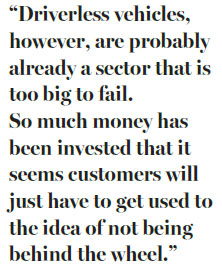
Driverless vehicles, however, are probably already a sector that is too big to fail. So much money has been invested that it seems customers will just have to get used to the idea of not being behind the wheel.
Massive advertising campaigns, coupled with the promise of lower prices for autonomous cars, will no doubt convince most consumers that they represent the future. The freedom and romance of driving the open road may in the future be confined to those who can afford it. Luxury carmaker Ferrari says it has no plans for a driverless version. Company boss Sergio Marchionne, asked whether there would ever be an autonomous Ferrari, said: "You'll have to shoot me first."
Others object to the current focus on the driverless revolution because it reinforces an existing trend toward private over public transportation systems. They argue that cities will continue to be planned on the needs of car owners, even if they are no longer behind the wheel, and suggest the investment would be better spent on improving train, bus and other communal transportation links.
From a safety perspective, driverless cars may appear to offer substantial gains. But, as a recent minor crash on the streets of Las Vegas indicated, foolish humans still have the ability to foil intelligent vehicles.
A driverless shuttle bus on its first outing had a minor bump with a truck, which police had no hesitation in blaming on its human driver. Experts also predict that inattentive pedestrians and cyclists could severely disrupt driverless traffic by simply wandering into the path of vehicles.
Surely, it's a logical next step to ban humans altogether if they cannot learn to interact with the robots.
The author is a senior editorial consultant for China Daily. Contact the writer at harveymorris@gmail.com.
(China Daily European Weekly 11/24/2017 page11)


Today's Top News
- China's national legislature to hold press conference ahead of annual session
- Well-being of people high on China's agenda
- Turning ancient wisdom into modern vitality
- GDP milestone lays solid foundation for blueprint rollout
- Wider conflict in Middle East feared
- China 'deeply concerned' over tension, UN hears





