



Recruiting efforts link China, Africa









Students flock to job fair in Beijing in hopes of taking advantage of the opportunities being presented by businesses going global
"Do you hire students from Ghana?"
Ebenezer Yeboah, a Ghanaian who is now in his final year of a master's degree in financial accounting program at Hubei University of Technology, posed this question in his not-so-fluent Chinese during a job fair in Beijing on Nov 15.
| An African studying in China talks with a Chinese employer at the job fair in Beijing on Nov 15. Pan Mengqi / China Daily |
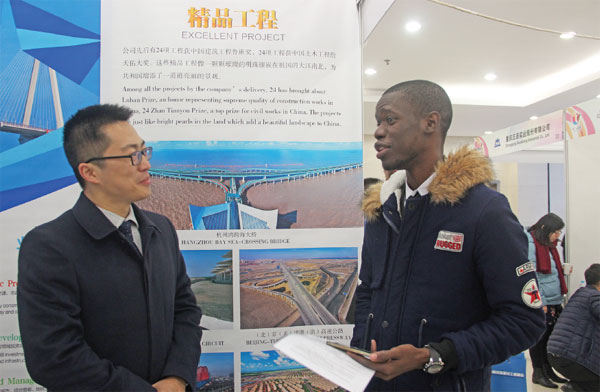
Nearly 400 Africans studying in China attended the fair. Beforehand, about 1,000 students from 52 African countries had submitted their resumes online. They were competing for nearly 500 jobs with 66 State-owned, local and privately owned Chinese enterprises, most of them with branches or business offices in Africa.
The job fair was for African students studying in China. It was organized by the Chinese People's Association for Friendship with Foreign Countries and the University of International Business and Economics.
For Yeboah, an ideal job would be related to his major. He took a high-speed train from Wuhan, where he is studying, to Beijing to attend the fair in order not to miss any opportunities.
"China's economy is important," Yeboah says, explaining why he wants to find a job with a Chinese company. He believes that working for such a company will help him gain valuable experience from the world's fastest-growing economy. For students whose majors are in the fields of economics and finance, China offers the "best practical course", he says.
Munyemana Jean de Dieu, who is studying computer science at Northeast Electric Power University in Jilin province, also wants to find a job with a Chinese company, since many of them have expanded their business into his home country of Rwanda. He says he hopes to find a job there.
Jean de Dieu has already sent his resume to 10 companies that took part in the fair. One is China National Heavy Duty Truck Group, which has a branch office in Rwanda.
Wang Liujie, a business manager at CNHDT's African office, says: "Our company produces half of the heavy trucks exported from China to Africa. More than 70,000 have been exported there for seven consecutive years."
According to Wang, the Belt and Road Initiative has helped many companies, including CNHDT, to do business in Africa. Thus, employees who know local languages and cultural habits are "extremely welcome".
"Exploring a new market is the first thing we do, so understanding the local language, culture and habits is very important. Chinese employees have no advantage in these fields, and they will be treated as outsiders," Wang says. "In the past, we hired African employees in Africa, mostly for the most basic and low-level jobs. This is the first time we have attended a job fair for African students in China. We want to hire high-level employees with skills in language and business negotiations, and a knowledge of both China and their home country."
Language and cultural familiarity were appreciated by many companies at the fair. Gong Qian, head of the international liaison office at China Tiesiju Civil Engineering Group, says interviewers first chat with the students in Chinese to test their basic knowledge of the language, then read their resume and learn about their experience.
"If Chinese enterprises want better access to overseas markets, including Africa, they must employ local employees, and foreign students in China are the best source, since they have knowledge and links to both sides," says Gong.
Linda Tefa, an African employee of Chao Wei Energy, based in Huzhou, Zhejiang province, says, "The best way for a Chinese company to get to Africa is to recruit Africans."
Tefa has worked for the company for less than a year. However, she has often visited Africa in that time, since she is a local employee who "knows the country, knows the people and knows the culture."
Tefa went to the job fair as part of the company's recruiting team, responsible for communicating with African students who could not speak Chinese.
Lin Guijun, deputy principal of UIBE, says that the Belt and Road Initiative has prompted more Chinese-funded enterprises to enter the African market and has increased the number of overseas students in China.
Lin says that hiring Africans studying in China will play an important role in promoting the localization of Chinese-funded enterprises and helping employ young Africans in China.
According to statistics from the Ministry of Commerce, China's nonfinancial direct investment in Africa was $3.3 billion in 2016, covering construction, leasing and commercial services, mining, manufacturing, wholesale, retail and other fields. The stock of various types of investments in Africa has exceeded $100 billion as the continent becomes an important destination for Chinese enterprises going global.
"Therefore, our association has built a bridge to give 60,000 African students who studied in China the opportunity to work and to give more than 3,000 Chinese enterprises that invest in Africa the opportunity to recruit local students in Africa," says Lin Yi, deputy president of the Chinese People's Association for Friendship with Foreign Countries.
"I hope these students will take back to Africa not only the knowledge and skills they have learned in China, but also the Chinese people's warm and deep-seated friendship with the African people, so that they can build a solid foundation for future cooperation."
According to a report released by the United Nations, Africa currently has a total population of about 1.2 billion, which is increasing yearly. In southeastern Africa, people between the ages of 10 and 24 account for 33 percent of the total population, and by 2025 Africa will account for one-fourth of the world's youth population.
He Wenping, chief researcher at the Institute of West Asia and Africa Studies at the Chinese Academy of Social Sciences, thinks that relying solely on education cannot solve the employment problem for many young Africans.
"The key is to create more jobs," she says.
She adds that, under the framework of the Belt and Road Initiative, Chinese-funded enterprises have provided more job opportunities in Africa.
"Education is one important aspect. In addition, companies must export technologies, projects and business in order to create jobs," she says.
At the job fair, the Chinese People's Association for Friendship with Foreign Countries and UIBE signed a strategic cooperation agreement. Both sides will work together in the future to promote educational exchanges and youth development, at home and abroad, within the framework of the Belt and Road Initiative.
panmengqi@chinadaily.com.cn
(China Daily European Weekly 11/24/2017 page18)


Today's Top News
- China's national legislature to hold press conference ahead of annual session
- Well-being of people high on China's agenda
- Turning ancient wisdom into modern vitality
- GDP milestone lays solid foundation for blueprint rollout
- Wider conflict in Middle East feared
- China 'deeply concerned' over tension, UN hears





