



New trends in RMB internationalization









Currency has met a good opportunity, but there is a long way to go before it plays an important role in global economic and financial system
In an open economy, when a big economy moves to become a powerful economy, its currency will naturally go global. China is no exception. However, due to the strong position and network effect of the US dollar, people still rely heavily on it and the internationalization of the renminbi is seriously underdeveloped.
Referring to the current use of major international currencies, the renminbi can only rank in sixth or seventh place. From the perspective of market share, there is still a considerable gap between the renminbi and the euro, the US dollar and the pound. For example, the RMB accounts for only about 2 percent of global international payments, about 2 percent of global foreign exchange transactions, about 1 percent of international reserves, and a lower proportion of investment and financing activities. This is not commensurate with China's economic status. China's economy, which accounts for about 15 percent of the global economy, is the second-largest in the world and contributes 33 percent of the world economy. The current economic growth rate is still far above the world average.
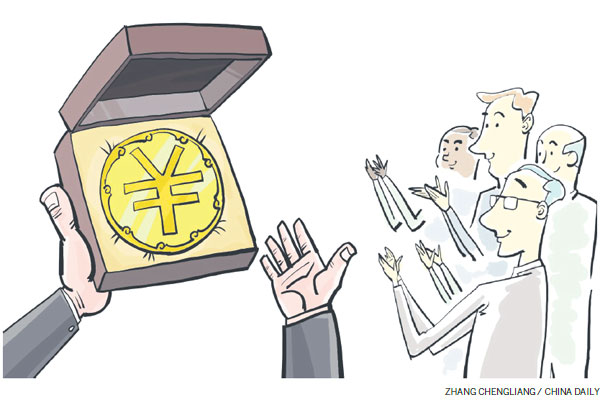
The low level of internationalization of the RMB is mainly due to the relative lateness in starting the process of internationalization of the currency. RMB internationalization began in 2009, when the it was mainly promoted through the trade channel.
By 2013, the People's Bank of China had officially started the process of renminbi internationalization through renminbi swaps and the gradual establishment of renminbi offshore financial centers in Hong Kong and Macao. However, by 2015-16, when the US dollar started to appreciate, China's economic growth began to slow down, so the process of RMB internationalization slowed and pessimistic opinions about the RMB's internationalization appeared.
However, in 2017, some new trends have emerged in the internationalization of the RMB.
First of all, the RMB exchange rate tends to be stable.
At the end of 2016 and early 2017, the RMB exchange rate and foreign exchange reserves were under greater pressure. At that time, the market generally agreed that the exchange rate of RMB against the US dollar would fall below 7 and even break 7.5 in the first half of 2017, but the exchange rate kept constant in the first half of 2017.
In September, the exchange rate of RMB surpassed 6.5 against the US dollar and set an 11-month record high. The balance of foreign exchange reserves has been rising for six consecutive months, and the one-way devaluation expectation has basically reversed.
In fact, both in terms of economic fundamentals and monetary and financial perspectives, there is no base for devaluation of the RMB. In the second quarter of this year, China's GDP growth rate was 6.9 percent, while the United States and the eurozone GDP grew by 2.6 percent and 2.1 percent, respectively. In October, the International Monetary Fund raised China's GDP growth forecasts for 2017 and 2018 by 0.1 percentage point to 6.8 percent and 6.5 percent, respectively. With confidence in China's economic growth gradually restored, the exchange rate is expected to remain stable in the fourth quarter of 2017.

Second, the renminbi is increasingly recognized internationally.
On Oct 1, 2016, the renminbi officially joined the IMF's special drawing rights basket of currencies, and the internationalization of the renminbi took a significant step forward. This step by the IMF to make the renminbi the fifth currency in the SDR basket shows that it views it as a "freely usable currency".
The entry of the RMB into the SDR sent a strong signal that the internationalization of the RMB has been recognized by the international community.
The acceptance of the currency by global financial institutions is also on the rise. According to survey data released by SWIFT this year, by June, more than 1,900 financial institutions had conducted RMB payment operations around the world, and financial institutions that use it for payment in different regions of the mainland or Hong Kong increased from June 2015 and increased by 5 percent in Europe, 19 percent in the Americas, 25 percent in the Asia-Pacific region and 5 percent in the Middle East. RMB foreign exchange transactions are also becoming more active.
The European Central Bank announced in mid-June that it will hold more renminbi and sell 500 million euros ($587 million; £444 million) worth of US dollar assets. Although the volume is not large, this is the first time that the ECB has invested in RMB reserves, which means that Europe has recognized the increasingly important role of the renminbi as an international currency.
The dollar status of oil is being shaken by the renminbi, too. In August, the Shanghai Futures Exchange and its subordinate Shanghai International Energy Exchange Center completed the RMB crude oil contract transaction environment's test, and the plan will officially be launched by the end of the year. It has drawn a lot of attention in the market. Venezuela, Saudi Arabia, Iran, Russia and other countries, being the main oil-exporting countries of China, may be willing to use the RMB to settle their oil exports.
Third, the Belt and Road Initiative is bringing substantive benefits to the internationalization of the renminbi.
Belt and Road and the RMB's internationalization are two important deployments for China, and the two have a synergistic effect. Construction of Belt and Road projects will generate tremendous demand for the renminbi and will increase the use of the currency in countries along its routes. In terms of trade, from 2014 to 2016, the total volume of trade between China and countries participating in Belt and Road was about 20 trillion yuan ($3 trillion; 2.56 trillion euros; £2.28 trillion), with a growth rate higher than the global average. As time goes on, such synergies will become increasingly evident.
In the long run, Belt and Road promotes the rise of Eurasian economies. While the United States can form its own cycle of economy in the Americas, its importance in Eurasia will gradually weaken.
Fourth, the expansion of free trade zones will create a return mechanism for the renminbi.
In 2013, the Chinese government began to build a free trade zone in Shanghai, and by this year the number of FTZs reached 11. FTZs are a useful part of the strategy of renminbi internationalization.
Finally, the recent trend of conservatism of US politics and economy on globalization and Europe's ongoing Brexit and populism issues have provided a good external environment for RMB internationalization.
Of course, RMB internationalization is not without worries and, to deal with these concerns, China needs to isolate external economic impacts, which means that its capital account will be under control for a long time, and inflow of RMB capital will also be subject to certain restrictions.
To sum up, RMB internationalization has currently met a good opportunity, but there is still a long way to go before the renminbi can play an important role in the global economic and financial system.
The author is a lecturer at the Management School of Shanghai University, a research fellow at China Europe International Business School's Lujiazui International Finance Research Center and vice-president of the BitSE Co. The views do not necessarily reflect those of China Daily.
(China Daily Africa Weekly 11/24/2017 page10)


Today's Top News
- Top-level engagement at two sessions helps translate vision of modernization into reality
- China's national legislature to hold press conference ahead of annual session
- Well-being of people high on China's agenda
- Turning ancient wisdom into modern vitality
- GDP milestone lays solid foundation for blueprint rollout
- Wider conflict in Middle East feared





