



Are tax cuts a US supply-side scam?









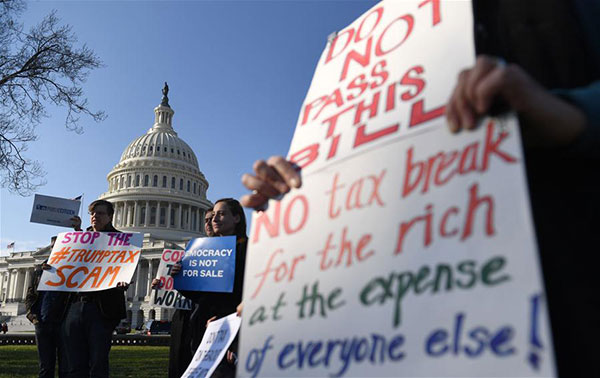 |
| People protest against tax reform on Capitol hill in Washington DC, the United States, on Dec 1, 2017. The US Senate on Saturday morning narrowly passed the Republican bill to overhaul the tax code in decades, moving one step closer to the first major legislative victory of the Trump administration and congressional Republicans. [Photo/Xinhua] |
Taking the lead from US President Donald Trump, the political case for tax cuts is that they are essential to “make America great again”. Over-taxed and cheated by bad trade deals, goes the argument, the United States needs tax relief to revive its competitive prowess.
Notwithstanding the political pandering to hard-pressed middle-class families, corporate America is clearly the focus of these efforts, with proposed legislation aiming to reduce business tax rates from 35 percent to 20 percent. Never mind that US companies currently pay a surprisingly low effective corporate tax rate, just 22 percent, when judged against post-World War II experience.
Pay no attention to the latest tally of international competitiveness by the World Economic Forum, which finds the US back in second place (out of 137 countries). And, of course, don’t draw comfort from the lofty stock market valuations of the broad constellation of US companies. Forget all that, Republicans insist: cut business taxes, and all that ails the US will be cured.
There are times when the politicization of economic arguments becomes dangerous. This is one of those times. According to the nonpartisan Congressional Budget Office, the cuts will result in a cumulative deficit of about $1.4 trillion over the next decade. The problem arises because the US’ chronic savings shortfall has now moved into the danger zone, making it much more difficult to fund multi-year deficits today than in the past.
Significantly, the US current account was in slight surplus during the big tax cuts of 1964 and 1981 — in sharp contrast to today’s deficit of 2.6 percent of GDP. With fiscal deficits likely to push an already low domestic savings rate even lower — possibly back into negative territory, as was the case from 2008-11 — there is a great risk of a sharply higher current account deficit. And a bigger current account deficit means that the already large trade deficit will only widen further, violating one of the main tenets of “Trumponomics”, that making America great again requires closing the trade gap.
It is at this point where the tale goes from fact to fiction. Trump and the congressional Republican majority insist that the proposed tax cuts will be self-financing, because they will spur economic growth, causing revenues to surge. This so-called supply-side argument, first advanced in support of the Ronald Reagan-era tax cuts, has been a lightning rod in US fiscal policy debates ever since.
Reality has turned out quite differently than the supply-siders envisioned. Yes, the economy recovered spectacularly from a deep recession in 1981-82. But that was due largely to an aggressive easing of monetary policy following the Federal Reserve’s successful assault on double-digit US inflation.
By contrast, the fiscal nirvana long promised by supply-siders never materialized. Far from vanishing into thin air, federal budget deficits ballooned to 3.8 percent of GDP during the 1980s, taking public debt from 25 percent of GDP in 1980 to 41 percent by 1990.
Not only did the supply-siders’ self-funding promises go unfulfilled; they also marked the beginning of the end for the US’ balance-of-payments equilibrium.
Far from a recipe for greatness, the Trump fiscal gambit spells serious trouble. Lacking in savings, outsize US budget deficits point to sharp deterioration on the balance-of-payment and trade fronts. Nor will creative supply-side accounting alter that outcome. A “dynamic scoring” by the nonpartisan Tax Policy Center suggests growth windfalls might prune the multi-year deficit from $1.4 trillion to $1.3 trillion over the next decade — hardly enough to finesse America’s intractable funding problem.
George H.W. Bush said it best when he was campaigning for the Republican presidential nomination in April 1980. He rightly criticized the “voodoo economic policy” of his opponent, Ronald Reagan. For today’s savings-short US economy, déjà vu is a painful understatement of what lies ahead.
The author, a faculty member at Yale University and former chairman of Morgan Stanley Asia, is the author of Unbalanced: The Codependency of America and China.
Project Syndicate





