



Japanese rightists rub salts in the wounds of history









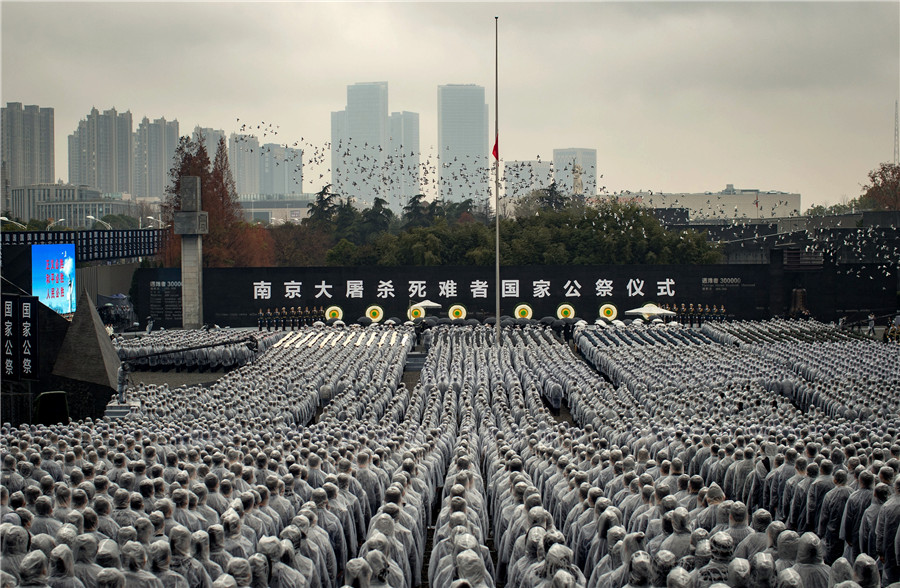
Politicians and bureaucrats have the historical responsibility to lead their people toward a new future. This year marks the 80th anniversary of the Nanjing Massacre. The National Memorial Day of the Nanjing Massacre will be observed on Wednesday, and the Chinese people hope the Japanese right-wing politicians would accept history and be cautious with their words and deeds at this sensitive time.
Japanese right-wing politicians' comments and activities are mostly responsible for the setbacks in Sino-Japanese relations. These politicians don't have any sense of history or strategic vision. Of late, when China-Japan ties were showing signs of improvement, about 60 Japanese lawmakers chose to visit Yasukuni Shrine, which honors among others 14 Class-A war criminals, casting yet another shadow on bilateral relations.
Japanese politics and diplomacy display two weird phenomena: right-wing politicians holding on their warped view of history and the government turning a blind eye toward their activities while pursuing an equally biased form of diplomacy.
The problem with Japanese right-wingers is not limited to their frequent visits to the Yasukuni Shrine; they refuse to acknowledge Japan's war past and the atrocities Japanese troops committed in many Asian countries, including China, before and during World War II. Japan still refers to those military aggressions as "that war", which means it refuses to repent for its past actions that made life hell for people in China, Korea and many other Asian countries and regions.
The Japanese government deliberately blurs the fundamentals, such as "the cognition to history" and "the responsibility for the war". Thanks to changed amnesty rules for imprisoned war criminals in the 1950s, which reduced the period required for eligibility for parole of those serving sentences from 15 years to 10 years and “pardoned” those dead, almost all the Class-A, Class-B and Class-C war criminals were rehabilitated by the end of 1958.
Japanese Prime Minister Shinzo Abe once said it is ridiculous to consider the A-Class criminals as such if they were not honored in the Yasukuni Shrine. And if the Japanese prime minister says so, why wouldn’t right-wing politicians follow him?
Abe has focused the most on education and security during his two terms in office, in an effort to revise Japan’s pacifist Constitution and build a country with great “national pride”. But since Abe's "dream" runs counter to history and Japan's pacifist Constitution, the road to achieve his Japanese dream is doomed to be bumpy.
Moreover, Japan's ring-wing forces have no idea how to bridge the social gaps and maintain ties with other countries, especially in Asia. And given the right-wingers' biased historical view, it is impossible for Japan to maintain good relations with its neighbors.
As for Japanese diplomacy, some scholars say it lacks "philosophy" and "direction", which reflect badly upon the Japanese politicians.
Looking back at Sino-Japanese relations over the past 20 years, Japanese right-wing forces have always thwarted China's attempts to deepen relations with Japan. From September 2009 to June 2010 when Democratic Party leader Yukio Hatoyama was the Japanese prime minister, Japan greatly improved its relations with Asian countries, including China. But on Sept 11, 2012, when Yoshihiko Noda, another Democratic Party leader, was the prime minister, the Japanese government “nationalized” China’s Diaoyu Islands, dealing a massive blow to Beijing-Tokyo ties.
Japan considers China a potential rival and follows the United States' strategy to curb China's peaceful rise. If Japan persists with this distorted policy, Sino-Japanese relations will never improve.
Japan has vowed to give shape to the US-led "Indo-Pacific" diplomatic strategy from next year to challenge the China-proposed Belt and Road Initiative. India is also on board the so-called Indo-Pacific plan, in order to form a quadrilateral "alliance" with the US, Japan and Australia, which puts a question mark on whether Asia’s three powers, China, Japan and India, will work together to revitalize the region.
The author is a researcher at the Institute of Japanese Studies, Chinese Academy of Social Sciences.





