



Africa doesn't need US advice on China









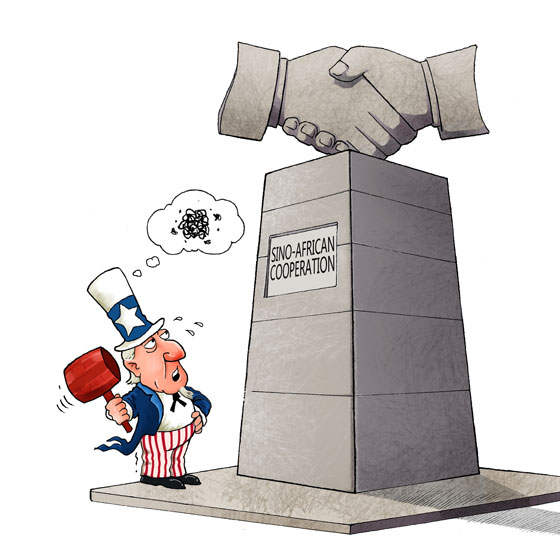
The recent visit to some African countries by Rex Tillerson, who was sacked as secretary of state by US President Donald Trump on Tuesday, appeared to have one major purpose: to arm twist African countries into abandoning the flourishing trade deals and ties with China. The statements Tillerson made on Africa-China relations were considered by many Africans as arrogant, undiplomatic, and abusive to African countries.
After his meeting with African Union Chairperson Moussa Faki at the AU headquarters in Addis Ababa, Ethiopia, Tillerson said America thinks it is important that African countries carefully consider the terms of Chinese investments in Africa because to the United States, China's investments do not create a significant number of jobs or training programs, or enable African people to participate more fully in the future. He also said China needs to follow international rules and norms.
These statements and assertions are not only insincere-given the conduct of the country he represents and the nature of US international engagement-but outright lies.
Political analysts described these remarks as a sign of desperation and poor diplomacy that will not change the relationship between Africa and China, but instead raise more questions about the US' motive to feel that its domestic policy of "America First" will also be imposed on Africa when it comes to the continent's relations with the rest of the world.
Moreover, to assume that Africa is getting a raw deal from China and therefore it needs advice from the "morally correct US foreign policy toward Africa" is an insult to African countries, insinuating that African countries don't know what they are doing or what they want.
Tillerson should know well that in business as well as diplomacy, a relationship is determined by interests. The US can engage with Africa without necessarily undermining China, as only interests determine the nature of the relationship and engagement with Africa.
Why does the US feel that it is more concerned about better trade deals for and the well-being of Africa than China, and what would make African countries believe this kind of view? Suffice it to say that China is more of a natural ally to Africa than any other country that claims so, because China directly supported African countries in their struggles against colonialism and oppression.
What has been Africa's historical relationship with the US? From the 16th to the 19th centuries, Africa was subjected to the worst human rights abuse in the form of slave trade. This evil transatlantic trade not only took Africans as slaves to America but also depleted African resources in vast quantities, while hundreds of thousands of Africans were killed in the process. The African people lost their dignity, and their wealth enriched the US. The slave trade radically impaired Africa's potential to develop economically and maintain its social and political stability. Historian Hugh Thomas estimates that at least 13 million Africans were shipped to the Western hemisphere, out of which 11.3 million were delivered to the new world while more than 1.7 million Africans were murdered in the process.
The recent threat by the US to impose sanctions on East African countries for banning the imports of second-hand clothes, in order to protect their nascent textiles industries, was an eye opener to many African countries to the unfair trade relations between Africa and the US. If for hundreds of years the US has exercised protectionism for its home industries, why does it seek to stop African countries from protecting their industries against unfair competition, especially that of used clothes? This is outright double standard, and it has been openly rejected by African countries.
Renowned African economist Dambisa Moyo says in her book, Dead Aid, that Africa has received more than $1 trillion of development aid from Western governments (including the US), but rightly observes that the money has not helped Africa but ruined it. Most of the aid money has been siphoned back to the Western countries through fraud and corruption. Among many of her advice to African countries to emerge out of poverty, one recommends encouraging the Chinese policy of large-scale direct investment in infrastructure, which is already happening in many African countries under China-Africa cooperation agreements.
The world of secrecy seems to be getting narrower and cheaters exposed. American author John Perkins has exposed how the US cheats countries around the globe out of trillions of dollars in the era of globalization. In the book, Confessions of an Economic Hit Man, Perkins gives detailed accounts of how the US, through international enterprises, convinces poor countries to accept huge development loans and ensure that the projects are contracted to US companies. Once a poor country is engulfed in enormous debts that cannot be paid back, the US administration demands more favors, such as "access to natural resources, military cooperation and political support", to give it more time or development loans to repay the debt. There is a lot of intrigue, greed and corruption linking the US administration and US corporations on how to steal from unsuspecting African and other poor countries.
Why is the US openly attacking China for its activities in Africa? Is it because the US influence not only in Africa but also in the rest of the world is threatened by China's lucrative deals and foreign policy of non-interference in other countries' internal affairs?
The China-proposed Belt and Road Initiative is considered a grand vision for infrastructure development and connectivity. Economist Pieter Bottelier says that it is a major vision of how China can collaborate with its neighbors, Europe and Africa, adding that the significance of the initiative has been underrated in the US and the West in general. Tillerson's recent remarks on China-Africa relations therefore smack of aggression by a country that has just come out of its slumber to realize that it has been outsmarted in terms of economic investments and engagement, and cannot think of a smarter alternative to get back what it thinks it has lost.
The author is a journalist based in Kigali, Rwanda, and is commentator on political issues in Africa.





