



Innovation in the times of quality growth









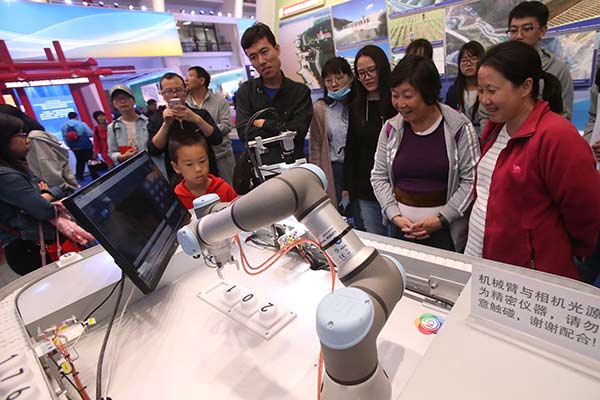
There is much talk about China's capabilities to innovate, its innovation policy and the growth that can be expected to result: What kind of growth and how much of it?
People have an innate desire to create, which can be traced as far back as prehistoric Homo sapiens and the Neanderthals before them. Innovation, however, means adoption alongside creation. And adoption takes place only when the new thing is seen to be profitable to use-more profitable than choosing any other new thing. So innovating is hard and success may be infrequent, to say the least.
Yet careers that invite efforts at innovating are highly valued. During the United States' glorious years from the 1820s to the 1960s, innovation was pursued by ordinary people as well as geniuses. Abraham Lincoln exclaimed in 1858: "Young America has a great passion-a perfect rage-for the new." This innovating was an engaging and often exhilarating experience: people were involved in their work and had a sense of taking action and of achieving things. Now, statistical analyses show that a low rate of innovation in a country is a reliable predictor of low life satisfaction.
US youths has lost innovation passion
It is clear that the US has lost that and it looks to tiny Silicon Valley for whatever innovation the economy is going to have. Is it also clear that China can take the place of the US as the world's greatest innovator?
The Chinese have always been a vital people and that helps. They have also shown the acumen-the business savvy-that is necessary if attempts at innovation are to materialize in actual innovations. It may be important that those aspiring to innovate have the ability to step back from the group in order to identify and think through any hazard.
For several years, now, China, under the leadership of President Xi Jinping, has taken initiatives aimed at boosting entrepreneurship and innovation in the business sector. An important initiative has dramatically shortened the process for forming a new company, thus inviting a huge increase in the number of enterprises from which innovation and entrepreneurship may spring.
(Published data suggest that an astoundingly large number of new companies-about 14,000-are registered every week.) Future history of New China will surely give a place for Premier Li Keqiang for seeing the value of an economy in which there is "mass participation" of people of varied backgrounds and talents experiencing the satisfactions of innovating.
Moreover, the government has recently recognized the importance of allowing competition in the economy. Individuals ought to be freed up to start new companies, and existing companies should be freed up to enter new industries. Competition is an invaluable solvent, dissolving and removing the enterprises that are "dead wood" and no longer viable.
Innovative efforts in supply side reform
Speaking at the World Economic Forum in Davos, Switzerland, in January, Liu He said that, under the new policy introduced two years ago, excess capacity in an industry is a signal that "supply" should be allowed to contract and prompt the less able companies to leave the industry. Liu, a member of the Political Bureau of the Communist Party of China Central Committee, said that similarly, excess demand is a signal to new companies to enter the industry. With this policy, he said, the government hoped "to make the supply side more adaptable and more innovative", adding that this reform appears to have worked. The growth rate of "total factor productivity", which had slowed for a while, picked up after implementation of the new policy.
But, thoughtful people have questions and worries. In China as well as the US, a great deal of innovation is in industries making capital goods and infrastructure or mining natural resources-call it "capital"-and there is little innovation in industries such as clothing, housing, healthcare and entertainment-call it "consumption". It is natural to ask whether such narrowly focused innovation can go on very long. In fact, data in the US show that an index of prices of capital goods has been steadily falling for several decades. This suggests that companies aiming to innovate-in China, too-will ultimately run out of possibilities for innovation in that direction. In short, economies have to achieve broad innovation or die.
A worry in the West is that the new technologies being created by this focused innovation, in expanding capacity in the capital-goods sector, also drives down wages in those industries. This phenomenon has brought high unemployment to several regions in the US, the United Kingdom and France. If innovation in China becomes similarly focused, it will be a worry in China too.
Economy capable of correcting imbalance
In my view, the economy may be capable of correcting that imbalance. The fall of wage rates in the affected industries has the effect of slowing down the growth of wage rates in the other industries-until wage rates have regained their former balance. And this slowdown will be a force gradually pushing up the rate of return to investment in the latter industries. The result will be a gathering boom in investment and ultimately a revival of wage growth and employment. Other healing mechanisms may also be at work. But this is possibly a very long adjustment process.
Some other concerns about innovation were aired with the rise of corporatism in Europe in the 1890s. (Prussian sociologist Ferdinand T?nnies was an important voice especially in 1920s Germany). One concern is that innovation was a headless horseman going in a direction that is largely unknown. The corporatists of that time, as now, regarded this as a profound failing of capitalism. The reply of mine is that the direction of the economy is not necessarily of great importance as long as participants-employees and bosses, investors and lenders-are finding that engagement in the processes of innovation are a rewarding experience and that the resulting growth of productivity is also valuable in meeting needs.
Another concern is that the innovation achieved in the economy may very well steer the economy in the direction that is not what is wanted by society. It may take some time to get to the bottom of this issue.
That brings us to the concept of "quality growth" put forward by Xi. I would suggest that China is big enough to be able to have both: a highly innovative business sector and a public sector that fills in the deficiencies and omissions of the business sector. Thus, China, with its two sectors, will be able to create a brighter future for its people.
The author, winner of Nobel Prize in economics in 2006 and the China Friendship Award in 2014, is an economist at Columbia University.





