



Mapping a way to avoid pollution









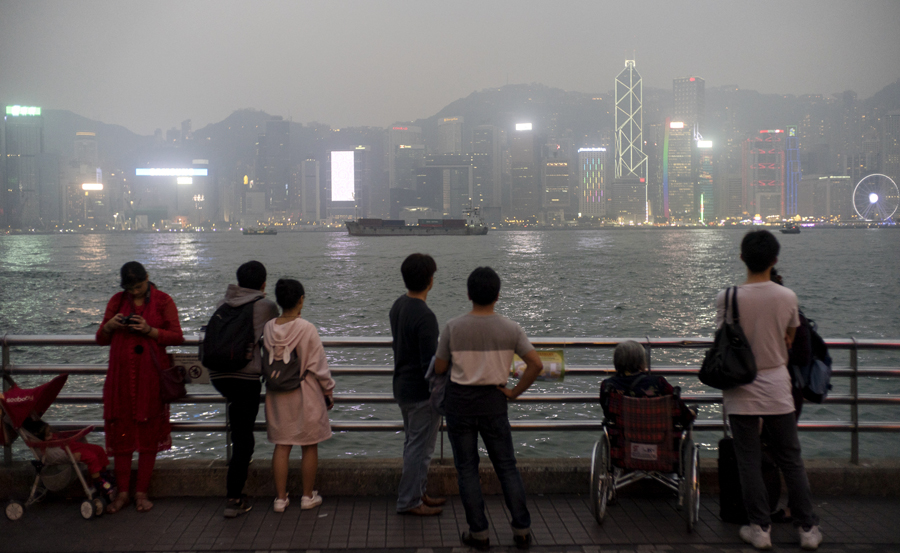
A team of researchers in Hong Kong is working on an application that will draw on artificial intelligence and big data to guide people away from air pollution hot spots, as Sylvia Chang reports.
With more than 1,700 deaths blamed on air pollution in the past year, Hong Kong is badly in need of help.
It is on its way in the form of an air pollution map produced with artificial intelligence.
However, it will take about five years for the application, designed by researchers at the University of Hong Kong, to emerge from the city's miasma of nitrogen dioxide, sulfur dioxide and ozone.
The map, capable of producing real-time readings or predictive analysis, will reveal where concentrations of toxic emissions are, and where they are likely to go. The app will not solve the pollution problem but it will allow people to see what they are getting into, and let them know if it would be better to change their plans.
The readings will show the concentration of pollutants right down to the level of the street they are on.
Badly polluted air can make outdoor exercise a health hazard, because tiny particles 30 times smaller than a human hair, known as PM2.5, can find their way deep into the lungs. The app will allow someone training for a marathon, children with physical education classes scheduled and people suffering from asthma to check PM2.5 levels and stay away from high concentrations, or even postpone training or going out that day.
According to the Hedley Environmental Index designed by the School of Public Health at the university, known as HKU, air pollution was responsible for about 1,780 deaths in Hong Kong in the past year.
Like a smartwatch, the system will be able to track a person's fitness and activity level. But, more important, it will also read the air quality and even forecast it for the next hour or next day. That means it will be able to advise individuals about suitable activities based on both air quality and their personal health and fitness.
Researchers say it will provide estimates of PM2.5 concentrations for any geographical area in Hong Kong, down to the hectare level.
"It's like weather reporting, on a real-time basis, to the street level," said Victor Li On-kwok, chair professor of information engineering at the university's Department of Electrical and Electronic Engineering, who is leading the team studying the system.
Hong Kong's Environmental Protection Department operates 16 air quality monitoring stations across the city, three of which are beside roads. They provide the public with the government-designed Air Quality Health Index, which converts air pollution concentrations into a scale ranging from one, at the low end, to 10-plus.
But Li challenges the accuracy of the air quality readings provided by the monitoring stations, arguing that the number of measurements is limited and the data is too scattered geographically.
"Air quality is not like temperature, the variation of which is very small within a day," Li said. "You can have one part of the city badly polluted, but just a few blocks away the air quality may be much better."
Li and his team are designing a data-driven air pollution estimation model, based on more than 10 types of data related to urban dynamics, including air pressure, humidity, temperature, wind speed, wind direction, traffic speed and more.
With the application of artificial intelligence, the model is able to transform the measurements from the 16 government monitoring stations into 110,000 virtual stations covering the whole city and bring readings right down to street level.
Their study, published in February in the peer-reviewed journal Environmental Science and Policy, collected data for ambient pollutant concentrations from the city's Environmental Protection Department, vehicular traffic data from the Transport Department, meteorological data from the Hong Kong Observatory, and urban morphology data, including road maps, from Baidu Maps.
Li said the estimated air pollution concentrations achieved an accuracy rate of 82 percent, and that would be improved to over 90 percent when additional data is incorporated into an improved model. The team is currently gathering data on the height and density of Hong Kong's skyscrapers.


- Foreign visitors taste the delicacies of Tianjin's ancient town
- China introduces a standard framework for humanoid and embodied intelligence
- CPPCC unveils agenda of the annual session
- Geologists brave rugged terrain in Yunnan prospecting mission
- Senior enterprise official facing probe
- China's anti-graft authorities reveal extent of year's work







