How peninsula peace process will proceed









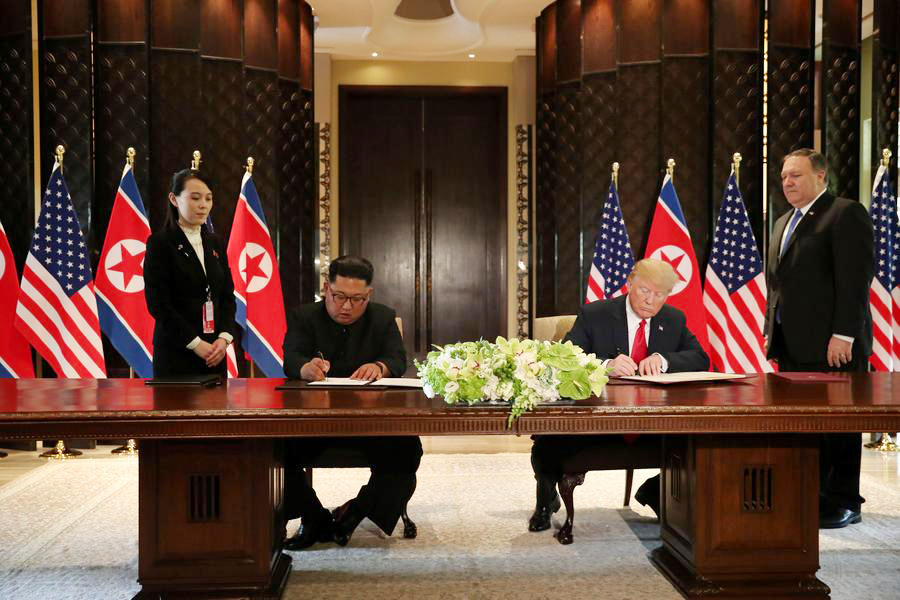
US President Donald Trump and the Democratic People's Republic of Korea leader Kim Jong-un signed a joint statement at their historic summit in Singapore on Tuesday. They also made important promises but without specifying them in the joint statement, which contains many uncertainties, such as those on the denuclearization of the Korean Peninsula and "complete, verifiable, irreversible denuclearization", as demanded by the US.
The results of the meeting suggest the United States has given quite a few concessions on the two crucial issues, which the two countries still disagree on.
The US had been insisting on complete denuclearization to resolve the peninsula nuclear issue. And it believed the Six-Party Talks suffered setbacks because of Pyongyang's non-cooperation on complete denuclearization.
The DPRK, on the other hand, believes that by giving up its nuclear program without a foolproof security guarantee from the US, it will lose its vital defense factor and bargaining chip in negotiations. That's why the DPRK insists on phased denuclearization with corresponding response from the US on security and other issues.
Since the Trump administration seems to be more pragmatic, it may adjust its policy, in order to resolve the complicated peninsula nuclear issue, which of course will need long-term efforts from both sides. And by agreeing to "complete denuclearization" in the joint statement, Washington seems to have given a tacit approval to Pyongyang's denuclearization proposal.
But the expression "complete denuclearization of the peninsula" reveals the other dispute between the two countries. What kind of denuclearization did Pyongyang and Washington respectively want?
For the US, it is obviously the complete denuclearization of the DPRK. But the DPRK sought three degrees of security guarantee from the US: stopping its joint military drills with the Republic of Korea, pulling US forces out of the Korean Peninsula, and removing the "nuclear umbrella" for the ROK and Japan, the US' close allies in East Asia.
Washington and Pyongyang had crossed swords on those issues before the Singapore summit. At the DPRK-ROK summit on April 27, Pyongyang expressed understanding of the US-ROK military drills but cancelled the inter-Korean high-level talks on May 16 because of the US-ROK "Max Thunder" drill. The DPRK's decision, in turn, prompted Trump to announce on May 24 that the US-DPRK summit in Singapore stands cancelled. Then to the world's surprise, Trump said he might consider stopping the "provocative" war games with the ROK because it would save the US a "tremendous amount of money". Which suggests he wanted the summit on schedule.
Although the details of and timeframe for the denuclearization process remain uncertain, the inclusion of "Peninsula denuclearization" in the joint statement secured "victory" for the summit. The world will now wait and see how the denuclearization process develops.
The DPRK has responded positively to the US' sincere moves. For instance, Kim told Trump on Tuesday that Pyongyang had destroyed a missile engine testing site and is committed to recovering the remains of the prisoners of war and people missing in action in the Korean War, including immediately dispatching those already identified.
But the DPRK's moves can be reversed. Missile and nuclear tests can resume. And the destruction of one nuclear test site and one missile engine test site will not have a great impact on the DPRK's existing nuclear weapons and missiles.
Yet the US-DPRK summit offers a significant opportunity to achieve a major breakthrough in the denuclearization process after decades of predicaments.
China has always called for peaceful talks and made tremendous efforts, through the Six-Party Talks for example, to restore peace on the peninsula.
Besides, Chinese and DPRK leaders exchanged views on a durable and stable peace mechanism during Kim's two recent visits to China. Realizing that regional peace depends on the DPRK's denuclearization in exchange for its security guarantee, China endeavored to strike a balance between the two factors, and proposed a "dual suspension" policy-the DPRK suspending its nuclear and missile tests in exchange for the US and the ROK suspending their joint drills-to restore peace on the peninsula, which played a constructive role at the Kim-Trump summit.
Now it is the responsibility of all sides to maintain and promote the peninsula peace process.
The author is a professor at the Institute of International Studies, Fudan University.