Law of the jungle an enemy for 21st century










History does not judge nations by their power alone, but by how they use it. When United States troops entered Venezuela on Jan 3 and abducted its president Nicolas Maduro and his wife, the world was not amazed by the absolute superiority of the US military technology but by the undisguised manner in which they defied the United Nations Charter and the fundamental principles of international law.
The US military operation was a seismic move that triggered widespread condemnation and profound concern across the international community. After all, how could the US, the self-proclaimed guardian of global order, invade a sovereign nation and seize its sitting head of state without any justification for the right of self-defense or even the pretense of Security Council authorization?
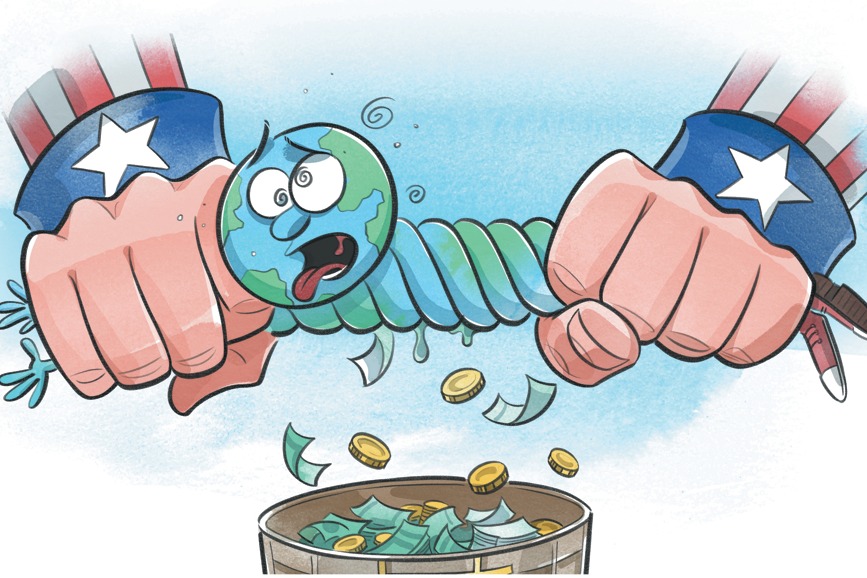
The "America First" policy is increasingly revealing its hegemonic logic — one that prioritizes the pursuit of short-term US interests, even if that comes at the cost of eroding the international rule of law.
To fully grasp how dangerous this is, let us turn to history. The devastating toll of World War II pushed the antifascist allies and other nations of the world to come together and build an international order anchored in the UN. At its core, this order upholds bedrock principles like sovereign equality, non-interference in other countries' internal affairs and a ban on the use or threat of force.
These tenets have since formed the legal backbone of global peace and development. The UN Charter explicitly stipulates that "all members shall refrain in their international relations from the threat or use of force against the territorial integrity or political independence of any state, or in any other manner inconsistent with the purposes of the United Nations". This provision is not an empty phrase, but a civilizational consensus that serves as the cornerstone for preventing hegemonic bullying and maintaining global stability.
It is precisely within this postwar framework of order — a system designed to prevent a return to chaos — that the world has maintained over eight decades of overall peace, averting the catastrophe of another world war and ushering in an unprecedented era of economic prosperity and development. On this foundation, the scale of global trade and investment has continued to expand, with billions of people lifted out of poverty to enjoy the dividends of economic and technological advancement.
There is no denying that the general peace and development the international community has enjoyed over the past eight decades are the most valuable public goods delivered by the international rule of law.
As the principal architect and the greatest beneficiary of this system, the US has not only gained enormous economic and strategic interests but also built its global leadership on the rules, concepts and institutions it advocates. These have become the source of its "soft power".
However, recent developments cannot help but cause concern that the ghost of 19th-century imperialism — rooted in the principle of "might is right" — is quietly reappearing. Whether in the actual armed violation of other nations' sovereignty and territorial integrity, or in the open defiance of international law norms and coveting of others' territories, the essence of such acts is to place the self-interest of one country above the justice and shared rules of the international community.
The resurgence of jungle law will be devastating for the international community. The US action against Venezuela has set a dangerous precedent that could intensify regional turmoil. The hidden dangers of refugee problems and transnational crime triggered by such turmoil will ultimately affect the US itself, causing it to reap what it has sown.
The legitimate authority and moral appeal that the US accumulated after World War II will be exhausted by the repeated trampling of the international legal order. If a nation leans entirely on coercive power and flouts international law, it will only trigger a global pushback — not earn the kind of legitimate leadership that lasts. In fact, this kind of approach is bound to boomerang in the end, spurring widespread resistance and even driving a wedge between the nation and its closest allies.
Once force becomes an acceptable tool of statecraft, trust evaporates and nations start viewing each other with suspicion rather than seeking cooperation. We have seen this happen in the past. The arms races and security spirals left smaller countries defenseless.
Should the rules-based order collapse, the world will regress into a chaotic state governed purely by power politics. In the nuclear age, even powerful nations cannot achieve a sense of security if the international order is dismantled. As Grotius — the father of modern international law — said,"Even the most powerful nations feel secure only in a society of law. When law is once abandoned, everything is shaken."
The progress of human civilization is essentially the process of moving from disordered hegemony toward ordered rule of law. The international order established after World War II represents the crystallization of humanity's collective wisdom in response to a catastrophe. To guard this order is to guard humanity's peace and future.
Only when all nations revere and practice international law, replacing confrontation with dialogue and competition with cooperation, can they firmly establish the foundation of global peace and prosperity, leaving for future generations a stable, just, and orderly world. Any attempt to challenge the rule of law or destroy the world order for private gain will ultimately be spurned by history.
The author is a professor at the Foreign Studies College and director of the Center for Global Governance and Law, Xiamen University of Technology.
The views don't necessarily represent those of China Daily.
If you have a specific expertise, or would like to share your thought about our stories, then send us your writings at opinion@chinadaily.com.cn, and comment@chinadaily.com.cn.