



Employers need to do more to prevent sexual harassment









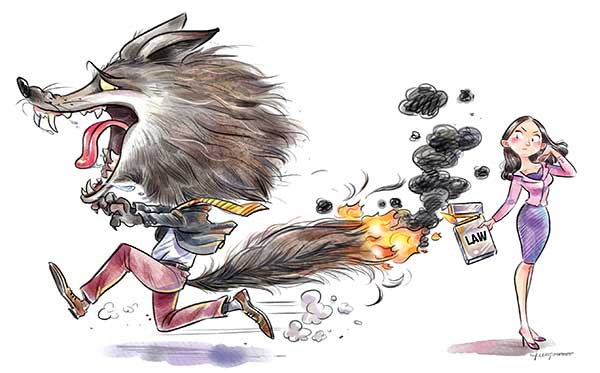
The frequent sexual harassment scandals exposed on social media have aroused wide public concern.
Although there are some clauses on sexual harassment in related laws and regulations, there should be specific legislation over employers' role in preventing sexual harassment in the workplace. Many believe the suggestion of experts in 2005 that employers take measures to prevent sexual harassment in the workplace, which failed to be adopted by the Standing Committee of the National People's Congress, could have been one such law. Again in 2012, the experts' suggestion that employers are responsible for preventing sexual harassment in the workplace failed to be adopted by the Legal Affairs Office of the State Council, China's Cabinet.
But China, along with European Union member states, Central and South American countries and African nations, have agreed to the International Labour Organization's plan to enact a convention on eliminating sexual harassment and violence in the workplace.
The Law on Protection of Women's Rights and Interests of 1992 added Article 40 on Aug 28, 2005, that forbids sexual harassment of women, and empowers the female victims to file complaints against such acts with relevant authorities and institutions. That made it clear the State forbids sexual harassment. And Article 58 explains how the victims can safeguard their rights and interests.
But the law doesn't mention sexual harassment in the workplace. As a result, to win a case against sexual harassment, the female victims have had to pay a heavy price, because it is not only difficult to prove that sexual harassment did take place but also to get appropriate compensation. Moreover, many female sexual harassment victims are under intense and unfair pressure of public opinion and even face retaliatory actions from the perpetrators.
In the past years, there have been reports about how female employees suffered from depression and even tried to commit suicide after facing sexual harassment in the workplace.
International practice shows anti-sexual harassment laws and rules should focus on prevention, as sexual harassment causes irretrievable damage to the victims' physical and mental health.
The obligation of employers to prevent sexual harassment in the workplace will be the core of the proposed ILO convention, which also includes the definition of sexual harassment and specific prevention and control measures.
In fact, the Women's Legal Research and Service Center at Peking University Law School, sponsored by some international organizations including UN Development Fund for Women and the ILO, has already launched sexual harassment prevention and control mechanisms in some pilot enterprises.
And Article 11 on Special Provisions on Labor Protection of Female Employees, which was issued in 2012, says the employers should prevent and stop sexual harassment against woman workers in the workplace. But it failed to stipulate the legal punishments for the employing units if they failed to do so, making the provisions not so effective.
The ILO's convention on eliminating sexual harassment and violence in the workplace requires the signatory countries to clarify the legal punishments for the employers if they fail to prevent and stop sexual harassment in their units, which is necessary for China's specific legislation against sexual harassment in the workplace.
But the employing units that fail to take measures to prevent and stop sexual harassment in the workplace should also be made liable to pay the appropriate compensation along with the perpetrator/s. This will force all the employers to follow the laws and regulations in letter and spirit and set up sexual harassment prevention and control mechanisms as soon as possible, in order to eliminate sexual harassment in the workplace.
The author is a professor of law at China Women's University.





