



China's infrastructure lesson for Africa









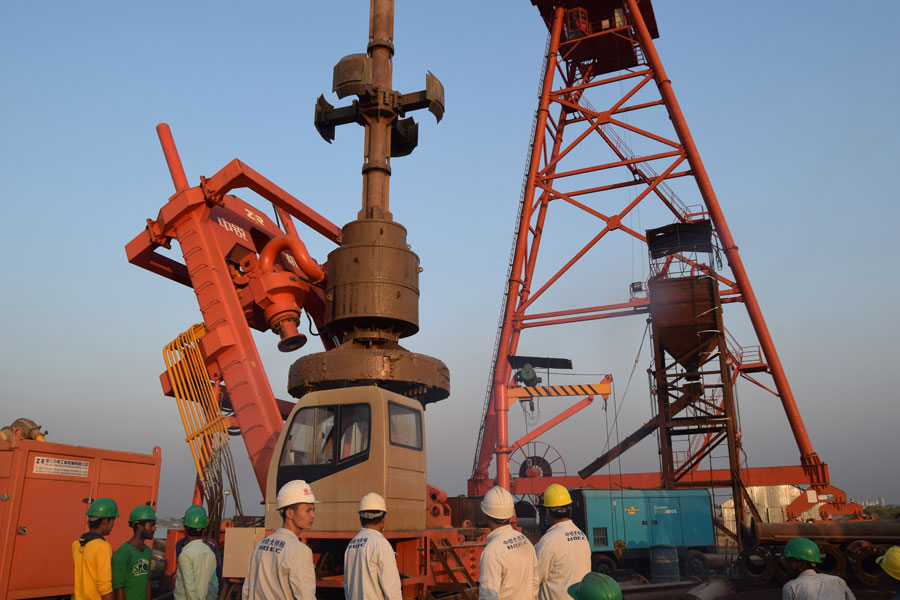
Padma Bridge in Bangladesh in August 2017. [Photo provided to China Daily]
There is a saying in China that if you want to be rich, you need to build a road and a bridge. Which is true, as the infrastructure facilities China has built over four decades of reform and opening-up have boosted its economic growth and helped it lift more than 800 million people out of poverty.
Infrastructure facilities are public goods that help improve productivity and people's living conditions, even in poverty-stricken areas. For China, infrastructure has facilitated economic development, and vice-versa.
First, the strengthening of water conservancy facilities has helped prevent floods and minimize the damage caused by natural disasters, and thus promoted agricultural development.
Second, the rapid expansion of transportation and communications networks has greatly stimulated the rural economy. China is set to connect all its rural areas to power grids, highways and 4G internet networks, which will improve the country's connectivity with external markets. That in turn will promote trade, reduce transaction costs and lay the foundation for rapid rural development.
Third, transportation infrastructure and economic growth promote spatial agglomeration. Studies have shown that every 100 million yuan ($14.57 million) spent on infrastructure could increase GDP by about 4.9 billion yuan.
African countries can learn from China's experiences to develop and improve their infrastructure and financing system. But to ensure those experiences are successfully implemented in Africa, the African governments have to play a leading role in infrastructure construction, because it is difficult to improve infrastructure by relying solely on market mechanisms.
The African Union has put infrastructure high on its agenda, with the African Infrastructure Development Plan for 2012-20 according top priority to continent-wide transportation, electricity and information networks, and cross-border water management. But while strengthening its implementation capacity to build effective coordination with the African countries to make the AIDP a success, the African Union should not ignore the debt risks.
Infrastructure is a double-edged sword which can be conducive to rapid economic development or, in some instances, become a heavy burden on a government. Besides, infrastructure construction could also result in a waste of resources if the infrastructure facilities are not fully used, which in turn will hinder development.
China and Africa both have lessons to learn in this regard. In particular, African countries need to reflect on how to manage the scale and speed of infrastructure construction.
China also included infrastructure construction in its five-year plans, which have had different characteristics in different periods of economic development. Infrastructure was given the second-highest priority-next only to the development of agriculture and township enterprises-h(huán)ighlighting the concept of scientific development.
Moreover, the introduction of market mechanisms in public goods supply promotes development. To overcome the shortage of funds for infrastructure construction, China follows the principle of marketization, that is, charges fees for the use of public goods, in order to share construction and operation costs, and promote rational and effective allocation of resources. For example, the income from the fees collected for using bridges, tunnels and ferries is used to repay the construction loans.
Furthermore, there needs to be diverse investment entities and broad financing channels for infrastructure construction. Infrastructure construction has gradually evolved into a diversified investment model based on finance, credit, capital markets, and foreign investment. As for investments in and financing for infrastructure construction, China has gradually introduced diversified investment and financing models such as build-operate-transfer, asset securitization and public-private partnership, after initially relying on financing support from the World Bank. These models have played a big role in some of China's important infrastructure projects.
Hopefully, African countries will make full use of China's experiences to expedite their economic development.
The author is a researcher on Africa studies, Chinese Academy of Social Sciences.
The author contributed this article to China Watch, a think tank powered by China Daily.





