



How to clean up bike-sharing firms' mess









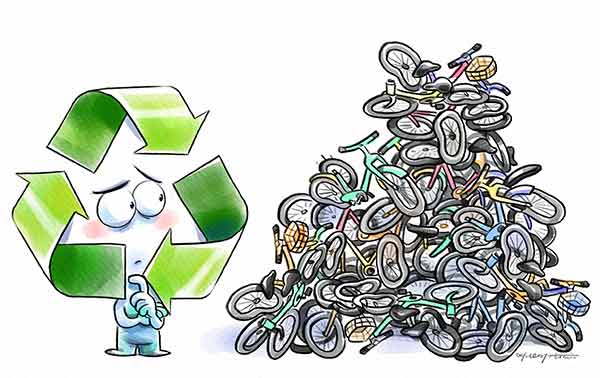
Editor's Note: Mobike, one of the biggest bike-sharing startups, recently launched a complete bicycle maintenance measure and began recycling the "lite 1.0 version" of its bikes with poor durability. Although building a circular economy was the original goal of the bike-sharing startups, thousands of broken-down bikes abandoned on the streets show the huge waste of resources. Two experts share their views on how to solve this problem with China Daily's Yao Yuxin. Excerpts follow:
Cooperation can solve shared bikes' problem
Zhu Dajian, a professor at the College of Environmental Science and Engineering, Tongji University, Shanghai
Bike-sharing is an innovative business model that allows startups to rent instead of selling bicycles to users, and thus curb material consumption while meeting the needs of consumers.
But in the pursuit of profits and the urge to seize market share, many companies invested huge amounts of capital in the sector regardless of the actual demand, which led to excessive overcapacity and damaged bikes, forcing many of the companies to declare bankruptcy earlier this year.
Indeed, the bike-sharing companies are obliged to dispose of their damaged and irreparable bicycles in an environmentally friendly way even after declaring bankruptcy. But the government could take precautionary measures that require all companies to pay a handsome deposit before launching a new business model, which at first glance may appear promising but could prove a failure in the long run, so that the bill for cleaning up the mess they leave behind is not footed by taxpayers.
Since shared bikes have a lifespan of roughly three years, most of them ought to be decommissioned next year. So the government should issue new rules in advance, for example, to ensure the existing bike-sharing companies publicize their recycling plan and do not introduce new bikes before properly recycling the old and damaged ones.
But because shared bikes provide public service while serving as vehicles to make profit, the government should consider granting subsidies to help the companies build enough space for parking and managing the bicycles.
And given that bike-sharing companies' efforts to solve the "last-mile" problem for commuters have resulted in the disorderly growth of the industry and created new traffic and logistics problems, the government should work out a sustainable and foolproof plan, perhaps with the existing bike-sharing companies, for urban transport development.
Clean up mess to take bigger market share
Zhu Wei, deputy director of the Communication Law Center, China University of Political Science and Law
Shared bikes are not necessarily part of a sharing economy where the norm is introducing more and more bicycles, without recycling the old ones. But the bike-sharing companies do benefit a society that wants to promote green transport and physical exercise, and solve the "last-mile" problem.
Although the bike-sharing companies are responsible for recycling their unusable bicycles lying on streets and in "bike graveyards" in many cities, most of them cannot do so because they don't have enough money to even return the deposits of customers. But it is unfair to spend taxpayers' money to clean up the bike-sharing companies' mess.
So the "winners" in the bike-sharing industry's competition could bear the cost of recycling the bicycles of the bankrupt enterprises and get the losers' market share. This seems possible now that only a few bike-sharing companies are left in the market and some enterprises-for example, Didi Chuxing, the ride-hailing giant that has taken over the third-largest bike-sharing but now bust company, Bluegogo-have entered the sector in search of more profitable ventures.
The government, on its part, should take measures to avoid unnecessary wastage of resources and the subsequent cost of cleanup before a new business model is introduced to the market, but it should still encourage emerging and innovative industries that are promising and eco-friendly.





