



Telling the story of Chinese rail









The day was Oct 22, 1978. This was the day Foreign Minister of Japan Sonoda Sunao welcomed an important visitor at the Toyko Airport — a leader of a foreign country. Who that leader was needs no guesswork. It was none other than the man who led China’s reform and opening-up, Deng Xiaoping. This visit, made by a leader who was then 74 years old, is significant.
This visit made China’s high-speed rail a reality. Author Wang Xiong in his book China Speed: Development of China’s High-Speed Rail makes a reference to this visit. He says despite a tight schedule, Deng was keen to travel on one of Japan’s high-speed trains. Answering a question from a journalist at a press conference, Deng expressed his experience traveling this way for the first time. “Fast,” he said. “It runs like the wind, and it feels like pushing you to run; we’re sitting on the right train.”
After opening up the Chinese economy and introducing many economic reforms, the Chinese dream of a high-speed railway network became a reality. But a delay in the introduction of this novel railway system by two decades owed to differences of opinion between Chinese policy makers on the necessity of such a system.
The start
China has the largest rail network in the world. The most amazing thing is this became a reality within a decade and a half. Even though China was interested in a high-speed rail system in the country as early as 1978, the actual establishment was delayed to some extent. Two months after Deng’s visit to Japan, the Chinese Communist Party held the Third Plenary session of the 11th Central Committee in Beijing. There, discussions took place about priorities for economic development. Since the maximum speed of the conventional railway system at that time was only 80 kilometers per hour, the necessity of establishing a high-speed railway system was discussed. While some who were for the proposal argued such a system would be an integral part of an economic development program, those who opposed felt it was too costly.
The year 1990 carries vast importance in the context of Chinese high-speed rail, because that was the year a report with proposals for a high-speed rail system was submitted to the State Council. Under this program the initial step was to construct a railway line between Beijing and Shanghai.
Under the guidance of the Scientific and Technological Commission, the State Planning Commission, State Economic and Trade Commission, the State Commission for Restructuring the Economic System and the Railway Ministry commenced discussion on major issues with regard to the construction, releasing a report of 50,000 characters. The report emphasized the need to expedite construction of the high-speed railway between Beijing and Shanghai and how such a move could contribute to the economic development of the country.
What’s special about Chinese rail?
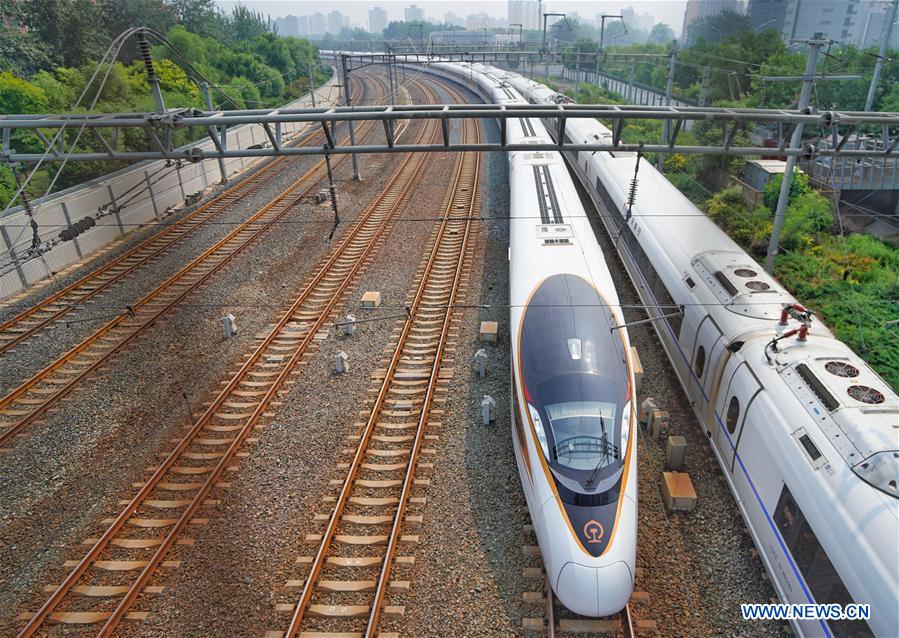
In 2008, China’s first high-speed railway with speeds of 350 km/h was opened, traveling between Beijing and Tianjin. The Harbin-Dalian high-speed railway, the first of its kind to travel on snow, opened in 2012. The Shanghai maglev, which runs at a speed of 431 kilometers an hour, has earned a place in the record books. Over the past 10 years, China has been able to accelerate progress and now boasts the longest railway network in the world.
By mid-2018, the Chinese railway network has spread over an area of more than 27,000 kilometers. At the end of 2014 it was 16,000. The aim is to further extend its range to 38,000 kilometers by 2025.
A further 7.54 billion passengers have used the railway between 2007 and 2017, and the income earned by the Department of Railways has reached 7.54 billion.
Global aspects of Chinese rail
Sponsorship of a rail line between Tanzania and Zambia in 1970 marked the first time China got involved in railway construction in another country. Having since experienced rapid progress in this field, China began to construct high-speed railway systems in many other countries. The first time China got involved in the construction of a high-speed railway system on foreign soil was in 2014, with the second phase of the Ankara-Istanbul railway. China is involved in construction of high-speed rail connections in countries the United States, Britain, Russia, Poland, Brazil, Rumania, Singapore, Malaysia, Cambodia, Vietnam, Laos, Burma, Thailand, Iran, Saudi Arabia, Venezuela, Libya and Turkey. In certain countries construction work has already been completed.
High-speed rail is now an integral part of both the economy and the country’s transport network. China has since surpassed even Japan, who started it all.
The author is a journalist from Sri Lanka.
The opinions expressed here are those of the writer and do not represent the views of China Daily and China Daily website.





