



Groups seek help for patients with rare diseases









Families must strive to provide best care, rehabilitation at home
Zhou Mi, a 16-year-old from Shanghai, was wearing pants and long sleeves to cover the red blisters on her arms and legs. Both her cheeks also were blistered.
Sitting in a wheelchair, she appeared much younger than she is.
Zhou has Epidermolysis bullosa, also called EB, the name for a group of rare genetic conditions that result in easy blistering of the skin and mucous membranes in the eyes, mouth, esophagus and respiratory tract, and for which there is no cure.
The wounds often become ulcerated, the skin is repeatedly affected and patients suffer lifelong pain.
"But don't shed any tears for her," said Zhou Yingchun, the teen's father, who spends hours once every two days cleaning her blisters. "She gets the best family care of her fellow patients."
According to doctors, before medicines become available to treat most patients with rare diseases, their families must provide the best care they can and rehabilitation at home so that the patients can be sufficiently healthy to qualify for medical treatment when it does become available.
"Even for patients with rare diseases where therapies are available, standard family care is crucial to improving their quality of everyday life to the maximum, postponing disease development and extending life," said Ding Jie, vice-chairwoman of the Expert Committee of Diagnosis, Treatment and Security of Rare Diseases with the National Health Commission. Ding is also a professor of pediatrics at Peking University First Hospital.
China has about 25 million patients with rare diseases, with 80 percent of these cases inherited. About 30 percent of patients do not live beyond the age of 5.
Treatment is available for only 6 percent of rare diseases, but most people cannot afford it, medical experts said.
Zhou Yingchun said that although his daughter wears pants and long-sleeved shirts every day, her skin frequently blisters. Whenever a blister develops, it must be punctured and the wound has to be bandaged.
"The skin is like liquid, rather than being solid," said the father, who four years ago set up the Shanghai Debra Butterfly Babies Care Center, which now has more than 800 patients from all over the country with Epidermolysis bullosa.
Zhou Yingchun said soft food must be prepared for his daughter as the mucous membrane in her mouth is fragile. Because of the tightened skin, patients' hands form fists. The average life span for those with this disease is around 40.
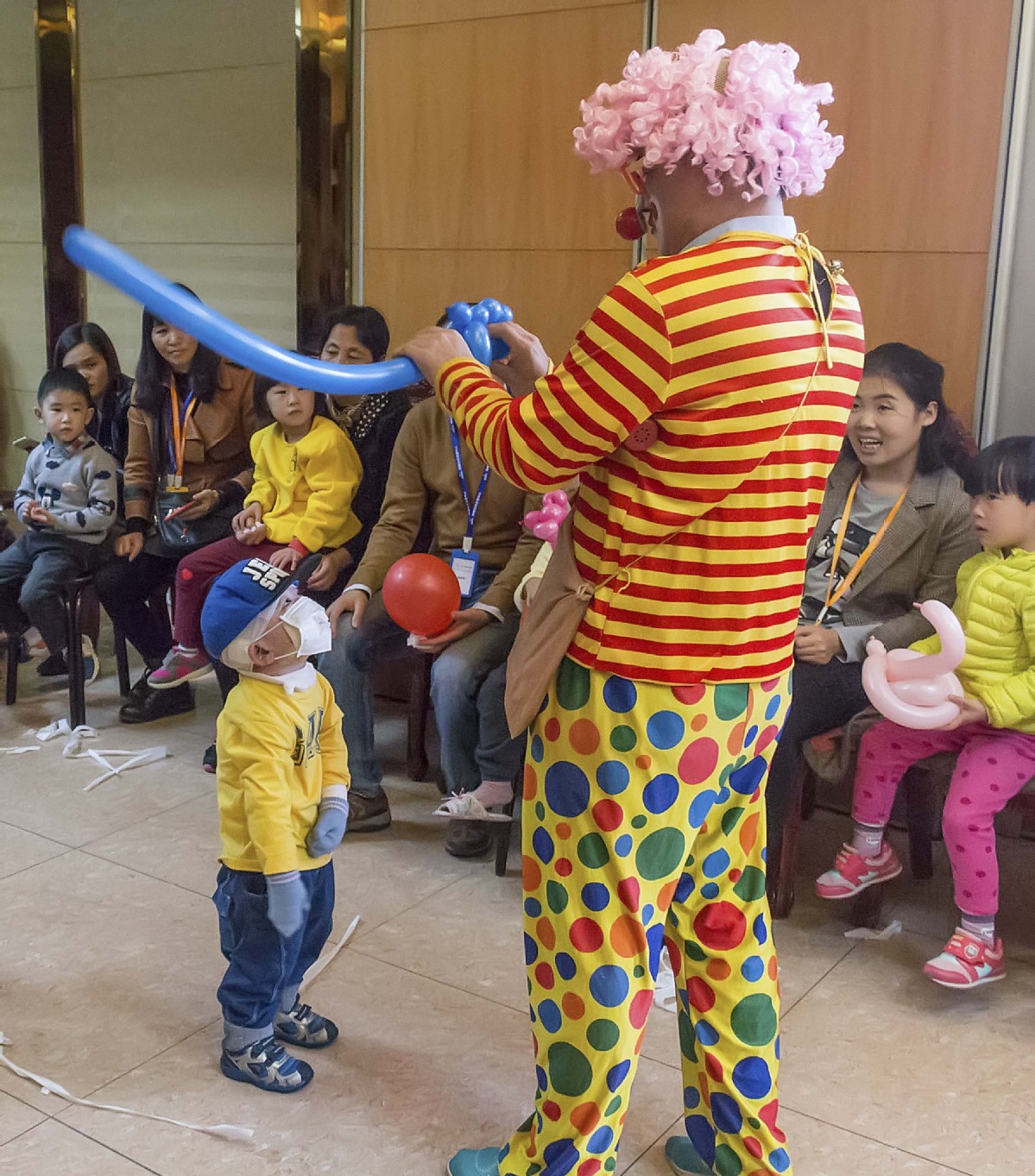
Velo Zou was born in Shanghai in November 2014. He was diagnosed with spinal muscular atrophy, also known as SMA, a genetic disorder that affects muscle control, and which afflicts 30,000 to 50,000 people in China.
When Velo was 9 months old, doctors predicted that he could live for as long as two years. About 95 percent of SMA patients die 18 months after birth.
Velo, which means "bicycle" in French, has a 6-year-old sister, Giro, which means "circle" in Italian. Their father, Zou Cheng, is a cycling enthusiast.
Velo's mother, Zhang Ying, said they provide the best care at home for the boy, who cannot sit by himself and has difficulty in coughing, holding a pen and going to the toilet.
Respiratory diseases can be fatal for such children, as they cannot cough to clear their throats. Velo's parents bought a machine to help him cough that cost 40,000 yuan ($5,835). He also has a tailor-made wheelchair and a standing frame, which helps him to practice standing to avoid bone deformity.
The proportion of SMA patients who use such supportive devices is very low, said Wang Yi, a pediatric neurologist at the Children's Hospital of Fudan University in Shanghai.
Only 2 percent of these patients use machines to help them cough, and 34 percent have never received rehabilitation training, according to a survey this year of 821 diagnosed patients nationwide, Wang said.
Velo's mother cuts his food into small pieces to help him to swallow it and uses medicine to help him go to the toilet.
Velo and each member of his family is injected with influenza vaccine annually to minimize the chance of him becoming infected with respiratory diseases.


- China introduces a standard framework for humanoid and embodied intelligence
- China's top political advisory body unveils agenda of the annual session
- Geologists brave rugged terrain in Yunnan prospecting mission
- Senior enterprise official facing probe
- China's anti-graft authorities reveal extent of year's work
- Former Haikou Party chief gets death sentence with reprieve







