



Mega bridge will boost Greater Bay Area









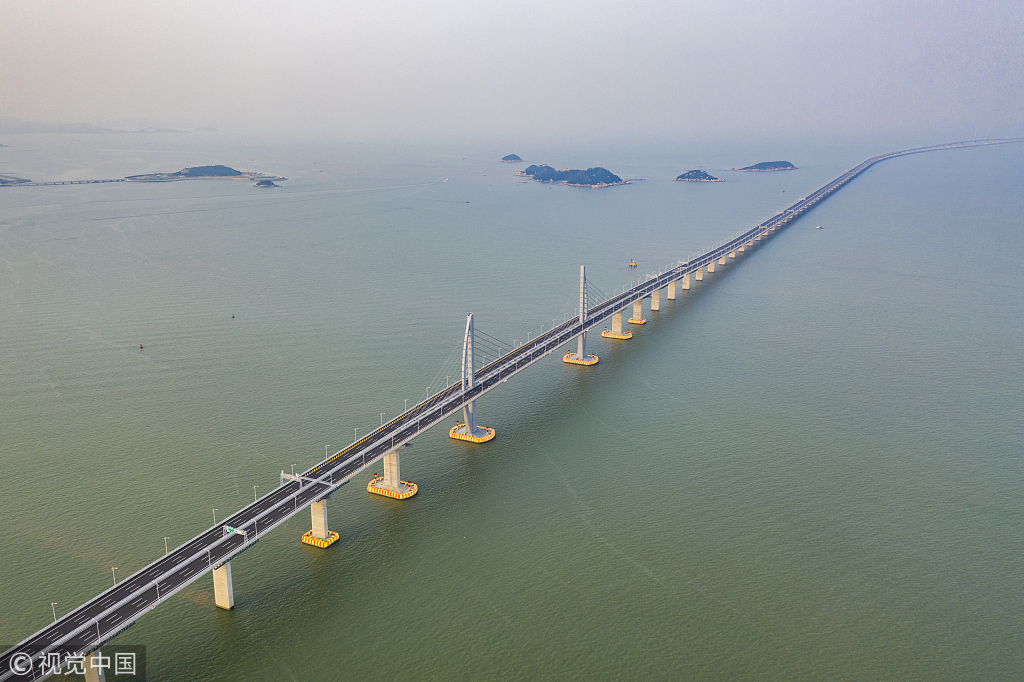
The potential of the Hong Kong-Zhuhai-Macao Bridge, which will open on Tuesday, has been underestimated by some experts due to their low expectations with regard to its logistic functions. But on the contrary, the bridge will play a crucial role in promoting the Guangdong-Hong Kong-Macao Greater Bay Area.
According to research conducted by the One Country Two Systems Research Institute, the mega bridge connecting Hong Kong, Macao and Zhuhai will have limited effects on freightage but it will have a significant impact on passenger traffic.
Under the economic environment of the Bay Area, particularly the western part, the bridge's transport function will focus on passenger traffic. In recent years, thanks to the close relations between the western Pearl River Delta, and the Macao and Hong Kong special administrative regions in areas such as tourism, cross-boundary consumption and service trade, passenger traffic among these three regions has been on the rise.
The bridge will give a big boost to cross-boundary passenger traffic as using it will not only be less time-consuming than the currently used circuitous land routes, it will also be more economical, flexible and stable than travel by sea. Demand for cross-boundary passenger transport is expected to increase significantly.
And prospects for the bridge's traffic volumes have received a boost from two policies. The first is that the bridge tolls for vehicles will be driver-friendly-between 60 yuan ($8.66) and 300 yuan per trip.
Frankie Yick Chi-ming, the lawmaker representing the transport sector, believes his constituents will find the tolls acceptable. This is because there can be significant savings in fuel costs if drivers use the bridge to get to the cities on the west bank of the Pearl River, instead of traveling all the way to Shenzhen and then taking Humen Bridge, which connects the Nansha district of Guangzhou to Humen town of Dongguan.
The second policy concerns private car drivers. As unveiled by Ip Kwok-him, a Hong Kong deputy to the National People's Congress, the authorities are considering issuing one-off permits which will allow Hong Kong residents to drive into Guangdong province for short trips. The idea is to let Hong Kong drivers without a mainland license apply for a permit online and drive around Guangdong for a short period after entering the province through designated ports.
Along with other favorable policies, which have already been implemented, the operation of the bridge is likely to enhance regional integration.
Greater cooperation and collaboration between Hong Kong and the western Pearl River Delta, as part of the Bay Area initiative, is a major value of the bridge.
The western Pearl River Delta is currently focusing on the development of modern service industries, with emphasis on development through closer cooperation and collaboration with Hong Kong, and using a professional service industry zone as a platform for industrial development. When the bridge is ready for use, Hong Kong's service industries will find it easier and more convenient to expand into the mainland market. Hong Kong should proactively seek stronger cooperation with the western Pearl River Delta in the construction of service industrial zones, as this would help lay a solid groundwork for industrial development in western Pearl River Delta.
The bridge is also likely to boost tourism. Guangdong, Hong Kong and Macao, all blessed with rich tourism resources, have positioned recreational tourism as a key industry. The bridge will make multi-stop journeys within the region much more convenient and attractive. To seize these development opportunities, the three regions should further coordinate tourism resources and adopt convenient exit-entry practices for tourists. This would help create a Guangdong-Hong Kong-Macao tourism cluster.
The bridge has the potential to help invigorate the Bay Area, particularly the western part of the region. However, just as Muhammad Yunus, a notable economist and Nobel Peace Prize laureate, once said: "Our challenge is to translate this extraordinary potential into meaningful change."
The author is research officer at the One Country Two Systems Research Institute, Hong Kong.





