



Coal's steady retreat from power generation gets underway









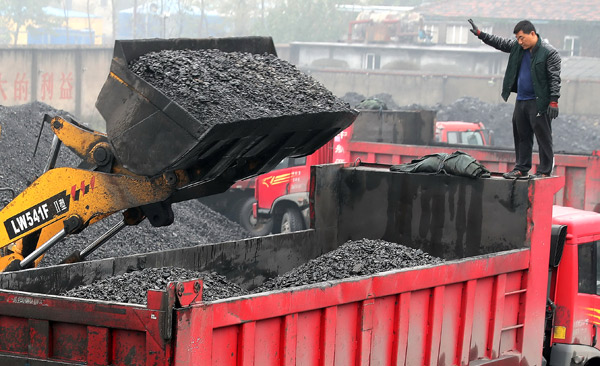
China has never disguised the fact that coal still dominates its electricity generation sector. But as people focus their attention on the quality of the air they breathe, and on the impact of climate change, the country is seeing a surge in renewable power generation.
As part of the 13th Five-Year Plan (2016-20), a total of 150 gigawatts of new coal capacity has been canceled or postponed until at least 2020.
Increasingly strict controls on total coal capacity and power plant emissions are expected to see the closure of older plants producing up to 20 gW, and spur technological upgrades to China's remaining 1,000 gW of coal power, according to analysts.
However, coal remains the country's largest source of electricity, accounting for more than 72 percent of its generation in 2015.
This is likely to change, though. Coal's share of power generation is expected to fall steadily to nearly 50 percent by 2040, as renewables and nuclear sources increase, according to the International Energy Agency.
"Climate change is real," said Chen Ning, vice-president at Goldwind Australia, a wholly-owned subsidiary of Xinjiang Goldwind Science & Technology Co, one of China's largest wind turbine manufacturers.
Clean energy, including nonfossil energy and natural gas, will replace coal as the primary source by 2030 and account for more than half of China's energy mix by about 2045, according to the CNPC Research Institute of Economics and Technology, a leading Chinese economic think tank.
In its long-term energy outlook released on Aug 15, it said that by 2050, coal, nonfossil energy, and oil and gas will each comprise one-third of the country's energy mix.
Yang Hua, planning director at China National Petroleum Corp, said in August the global energy mix is moving in a "high-efficiency, clean and low-carbon direction".
Considering China's significant role in global energy consumption, the country's shift toward cleaner energy will be a role model for the rest of the world, Yang said.
For years, the dominant energy narrative on China concentrated on the extraordinary pace of the country's development, the success in lifting hundreds of millions of people out of poverty (including energy poverty), the scale of industrialization and the demand for energy resources, most notably coal.
Now, the country is moving quickly toward a services-based economy and a much cleaner energy mix, according to the IEA's World Energy Outlook published in November last year.
This new direction will have consequences that are equally significant for China and the world, the IEA said.
The Institute for Energy Economics and Financial Analysis, in Cleveland, United States, which carries out research and analysis of financial and economic issues related to energy and the environment, said solar and wind generation have grown more rapidly than other electricity-generation sources in recent years.
Nicolas Pechet, a partner at the Asia-focused corporate strategy consulting company Solidiance in Shanghai, said China recognizes that cutting energy consumption alone will not be sufficient to reduce its greenhouse gas emissions from coal. "It also needs to generate more renewable energy," he said.
Since 2013, China has been the world's leading installer of solar photovoltaics - the process of converting sunlight into electricity.
In 2015, the country became the world's largest producer of photovoltaic power, narrowly surpassing Germany. Chinese solar panel manufacturers are estimated to have a 20 percent cost advantage over their US peers, owing to economies of scale and more advanced supply chain development, Pechet said.
A large part of the installed capacity for solar power in China is in the form of large solar photovoltaic power plants in the west of the country, which are much less populated than eastern areas, but boast better solar resources and available land.
"Ironically, one way China is expanding its solar capacity is by building solar panels on abandoned coal mines," Pechet said. "One such project in Shanxi province covers 160 hectares and can produce enough electricity to power 30,000 homes," he said.
A report by Bloomberg New Energy Finance in August said wind and solar energy will account for about 50 percent of the power produced globally by 2050, aided largely by lower costs, with China leading the way.
The country will be at the forefront of increased clean energy generation, while power storage will benefit from rapid advances in battery technologies, the report said.


- Guangzhou railway hub tops 10 million passengers since start of holiday travel rush
- Shanghai Jiao Tong University celebrates 130th anniversary with illumination ceremony
- Over 100 domestic, foreign teams to take part in intl embodied robot application competition
- Former Hebei official expelled, case sent for prosecution
- Former Guizhou political adviser expelled, dismissed for graft
- Ice and snow activities, desert hot springs draw holiday crowds to Aksu, Xinjiang







