



Researchers develop HPV breakthrough









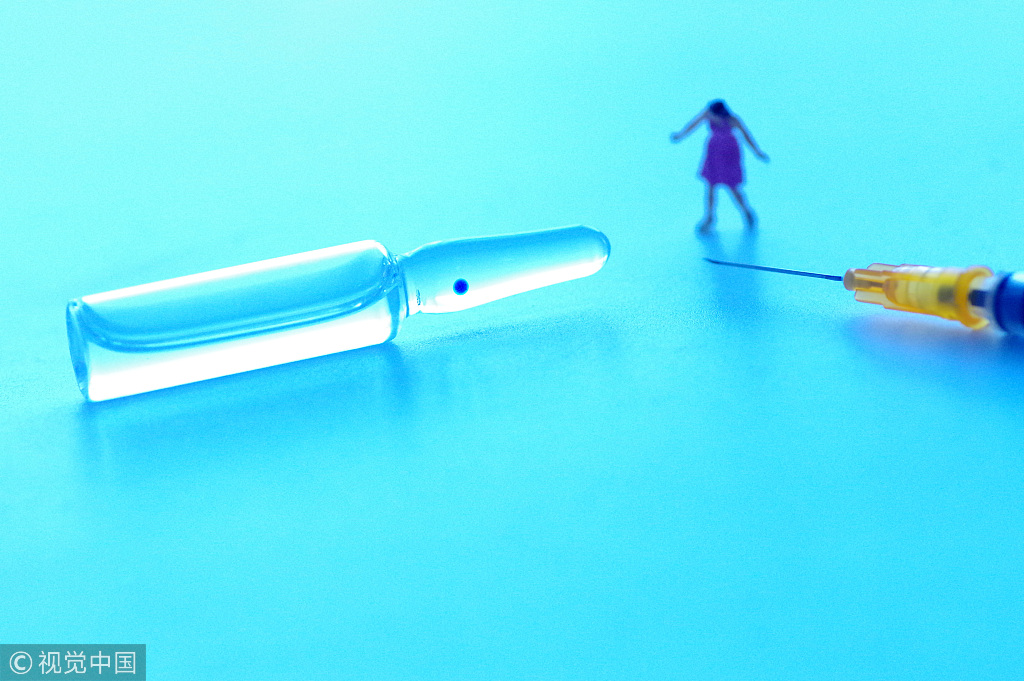
Vaccine candidate offers prospect of better protection against cervical cancer
Chinese researchers have taken a major step forward in developing a new-generation vaccine with the potential to offer protection against almost all the most lethal forms of human papilloma virus, or HPV.
HPV is primarily transmitted through sexual contact. More than 200 distinct HPV types have been identified, of which at least 18 are high-risk types associated with 99 percent of cervical cancers, the second-most-common cancer among women, after breast cancer.
The Gardasil 9 HPV vaccine, which is currently available, provides the broadest protection against infection from nine HPV types, seven of which can cause 90 percent of cervical cancers. However, it remains unclear whether widespread immunization with vaccines like Gardasil 9 could lead to an increase in infection rates from the other cancer-related HPV types.
To expand type coverage, the approach used in previous vaccines was to increase the number of virus-like particles. One particle resembles one HPV type, and it can elicit immunity to that type. The more particles a vaccine has, the broader the protection it provides.
However, this approach is fraught with difficulties, as an increase in type coverage dramatically enhances protein amounts and immunological agent levels per dose, causing side effects such as pain, swelling and fever and raising manufacturing complexity and production costs.
Researchers at Xiamen University in Fujian province have developed a new vaccine candidate that can protect against more HPV types with fewer particles.
They divided 20 major HPV types - including HPV6 and HPV11, which account for 90 percent of genital warts - into seven groups based on genetic relationships and found that genetically close HPV types share high structural similarities.
Lead researcher Xia Ningshao compared the virus or the vaccine to a "ball". All HPV types are similar in appearance, but differ significantly on the ball's surface, with features such as veins and convex and concave areas. These structural features on the surface are called loops.
"Because of the loops, one type of vaccine can stimulate the production of antibodies only against the infection of one type of virus, and is unable to prevent infection by other types," Xia said.
Using a loop-swapping approach, researchers engineered a complex virus-like particle with the loops of three genetically close HPV types: HPV33, HPV58 and HPV52.
They tested the triple-type particle in experiments on mice and monkeys, and found it could provide high immune potency - comparable to a combination of three virus-like particles.
The new approach was equally successful in developing another four triple-types using the other 12 major HPV types.
"The research paves the way for an improved HPV vaccine made of seven triple-type virus-like particles to protect against as many as 20 HPV types," Xia said.
The results were recently published in the international journal Nature Communications. Reviewers said the new-generation vaccine candidate was "a remarkable achievement" for having broader type coverage, lower cost and lower amounts of proteins and agents, and "will be moved forward into a clinical trial".
Three HPV vaccines have been introduced in China, covering two, four and nine types. The three-shot HPV vaccination covering nine types is priced at 3,894 yuan ($567). In some areas, scalpers sell doctors' appointments to get it for more than 6,000 yuan, a cost that is prohibitive for many poor women.
Researchers say the new-generation vaccine candidate will be available for females age 9 to 45, and its cost will not exceed that of the vaccines currently available.
Two HPV vaccines previously developed by Xiamen University have reached the clinical test stage and are expected to enter the market this year and in 2022.
The world's first HPV vaccine, Gardasil, was developed by Chinese cancer researcher Zhou Jian, who died in 1999, and Australian immunologist Ian Frazer. In 1995, they started cooperating with Merck and Co to develop the vaccine.
According to the World Health Organization, there are about 570,000 new cases of cervical cancer, and 311,000 deaths from the disease, reported worldwide every year. China has a high incidence and death rate, with 106,000 new cases reported last year and about 48,000 deaths.
Xinhua


- Senior enterprise official facing probe
- China's anti-graft authorities reveal extent of year's work
- Former Haikou Party chief gets death sentence with reprieve
- Purchase of US-made weapons to push Taiwan closer to the peril of war: spokesman
- WIC calls for submission of cultural heritage digitalization cases
- China calls for global opposition to Japanese neo-militarism










